Lebanese women fight frizz daily — and most have been fighting it with the wrong tools and the wrong understanding of what it actually is. Frizz is not a hair type. It is not genetic. It is not inevitable. Frizz is a symptom of a specific imbalance between your hair's moisture level and the moisture level of the air around it — and in Beirut, that imbalance is one of the most extreme anywhere in the world. Understanding what causes frizz in Lebanese hair specifically changes everything about how you treat it.
Frizz Science · Lebanon · 2026
Why frizz is worse in Beirut than almost anywhere else — and what that means for how to stop it
75–90%
Coastal humidity in Beirut Aug–Sep
18–22°C
Indoor AC temp — the humidity shock zone
5–8×
Daily indoor–outdoor transitions for most Lebanese women
Why Lebanese Hair Frizzes — The Science in Plain Language
There are four distinct causes of frizz in Lebanese hair. Each requires a different fix. Treating the wrong cause is why most anti-frizz routines fail.
This is the dominant frizz type for Lebanese women — and the one most affected by Beirut's specific coastal conditions.
The science
Hair's cuticle scales open and close based on the difference between the hair's internal moisture content and the humidity of the surrounding air. When Beirut's ambient air contains more moisture than the hair shaft, the cuticle opens to absorb it — causing the individual strands to swell unevenly and the surface to roughen into frizz. Freshly heat-styled Lebanese hair with an open, positively charged cuticle is the most vulnerable state — and stepping outside in 80%+ Beirut humidity immediately after styling is why Lebanese women's styles collapse so quickly. The fix is sealing the cuticle before outdoor exposure — not after frizz has already started.
Frizz that exists even in low humidity — even indoors in the AC — is almost always damage frizz, not humidity frizz. The cuticle is physically damaged and cannot close regardless of conditions.
The science
Metal tools with hot spots, incorrect heat temperatures, and aggressive brushing all permanently lift cuticle scales at their contact points. Unlike the temporary cuticle opening that humidity causes, damage-lifted cuticle scales are structurally deformed and cannot close — creating permanent frizz patches that exist regardless of humidity levels, at every location where heat or mechanical damage occurred. Lebanese women who experience frizz in their Beirut apartment's AC are dealing with damage frizz, not humidity frizz — and treating it with a humidity barrier product will not resolve it.
Lebanese women who wake up with significantly more frizz than they went to sleep with are experiencing overnight mechanical frizz — the cuticle disruption from hours of cotton pillowcase friction that recreates frizz pattern while they sleep.
The science
Cotton pillowcase fibers create friction against hair's cuticle scales with every movement during sleep. Eight hours of this friction progressively disrupts the aligned, smooth cuticle direction that was set during styling — mechanically recreating a frizzy cuticle pattern overnight. Lebanese women who spend 20 minutes achieving a frizz-free style before sleep lose it to 8 hours of cotton friction — waking with substantially more frizz than they went to sleep with, which they incorrectly attribute to humidity when it is actually mechanical disruption.
The specific indoor frizz Lebanese women experience in heavily air-conditioned environments — malls, offices, cars — is often static frizz rather than humidity frizz. The diagnosis matters because the fix is different.
The science
Air conditioning removes humidity from the air and simultaneously generates static charge. Lebanese hair in AC environments loses internal moisture to the dry air while accumulating a positive electrical charge on the outer cuticle — causing individual strands to repel each other and fly outward. This is why hair frizzes differently in the car's AC versus outdoors in Beirut's humidity — they are electrically opposite problems. Ceramic tool styling — which emits negative ions that neutralize the positive charge — is the most effective prevention for static frizz specifically.
The 6 Fixes — One for Each Frizz Cause, and the Ones That Work on All of Them
Match the fix to the frizz cause. Fixes 5 and 6 address all four causes simultaneously — start there if you are not sure which type you have.
This is the most impactful single change Lebanese women can make for humidity frizz — and the one most Lebanese women are not doing because they apply frizz products after frizz has already started, rather than before it begins.
Why timing is everything for Lebanese humidity frizz
A humidity barrier works by sealing the cuticle before humidity contacts it — preventing the open-cuticle moisture absorption that causes swelling and frizz. Applied after Beirut's humidity has already entered the hair shaft, even the best barrier product cannot undo the swelling that has already occurred inside the cortex. The product must go on before outdoor exposure — consistently, every styling session, without exception.
The action
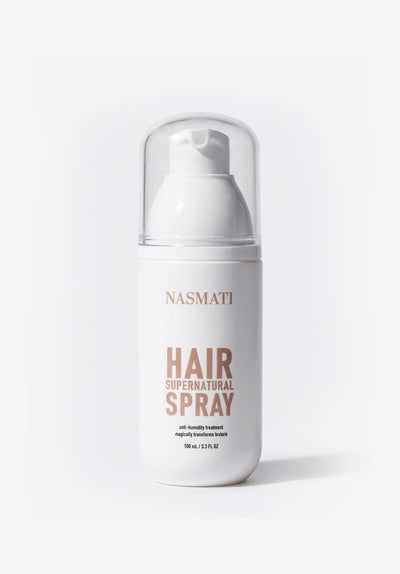
Apply Nasmati Supercoat immediately after styling — before the AC vent, before the window, before the front door. 2–3 light passes from 25cm distance. Do not wait until you notice frizz starting. The seal must be on before outdoor exposure in Beirut.
The Humidity Frizz Fix
Supernatural Anti-Frizz Humidity-Proof Supercoat
Seals the cuticle against Beirut's coastal humidity before outdoor exposure — the only approach that actually prevents humidity frizz rather than attempting to reverse it after it has started.
Shop Now →
Damage frizz cannot be fully resolved while the tools causing the damage are still in use. Every session with a metal tool adds more permanently lifted cuticle zones — while simultaneously the hair is trying to repair through Argan Oil treatments. It is a one-step-forward-one-step-back cycle until the damage source is removed.
The action
Check your current tools for hot spots: run fingers along a section immediately after the tool passes through — if some areas feel noticeably dryer or rougher, the tool has hot spots creating permanent cuticle damage. Replace with full ceramic Nasmati tools where every contact point delivers identical heat — zero hot spots, zero new permanent cuticle lifting zones added with each session.
The Damage Frizz Fix
5-in-1 Magic Hair Curler — Full Ceramic
Zero hot spots across all five barrel sizes — no new permanent cuticle damage zones created with each styling session. CE/FCC/ROHS certified for consistent thermal performance on Lebanese hair.
Shop Now →
The fastest-acting frizz fix for Lebanese women who wake up with more frizz than they went to sleep with. Results are visible the first morning after implementation — this is not a gradual improvement habit, it is an immediate change that works overnight.
The action
Secure hair in a loose pineapple (for wavy/curly Lebanese hair) or low bun (for straight Lebanese hair) with a Satin Scrunchie before sleep — every night. The satin surface eliminates the mechanical cuticle disruption that cotton creates. Hair that is gathered off the pillow surface has even less friction exposure. First-morning results: significantly less frizz, more manageable texture, less re-styling required.
The Overnight Frizz Fix
Satin Crystal Scrunchies
Reduces overnight cotton friction against Lebanese hair cuticle by up to 43% — the specific friction that recreates frizz pattern during sleep. Results visible from the first morning. Takes 30 seconds. Zero effort cost.
Shop Now →
Frizz-prone Lebanese hair is almost always moisture-deficient Lebanese hair. The cuticle opens to absorb humidity from the air because the hair's internal moisture level is too low — the hair is seeking equilibrium with its environment. Restoring internal moisture reduces the cuticle's hunger for external moisture.
The science
Hair with 10–15% water content has a cuticle that responds minimally to ambient humidity — the internal-external moisture differential is small enough that the cuticle barely opens. Hair at 5–6% water content (common in Lebanese women who style frequently without protection) has an extreme moisture deficit that causes the cuticle to open aggressively at even moderate humidity levels. Restoring cortex moisture through weekly Argan Oil treatments progressively reduces the differential that drives frizz — making Lebanese hair less reactive to Beirut's humidity from the inside rather than just sealing the outside.
The action
Night before wash day — apply Argan Oil generously to dry Lebanese hair, roots to ends. Leave overnight minimum. Wash out in the morning. After 3–4 weekly treatments, the hair's baseline moisture level rises enough to visibly reduce humidity reactivity — the cuticle stops opening as aggressively to external humidity because the internal deficit has been reduced.
The Internal Moisture Fix
Moroccan Argan Oil — Weekly Deep Treatment
Penetrates the cortex to restore the internal moisture level that reduces Lebanese hair's humidity reactivity from the inside — making the cuticle less likely to open aggressively in Beirut's conditions rather than just sealing the surface after it has opened.
Shop Now →
Brushing is one of the most overlooked frizz amplifiers for Lebanese women. The specific way thick Lebanese hair is brushed determines whether each session smooths the cuticle or disrupts it further — making existing frizz worse before it is even styled.
The science
Hair cuticle scales overlap like roof tiles, pointing from root toward tip. Brushing from root to tip pushes against the direction these scales naturally close — lifting and disrupting them with every stroke. Brushing from ends upward on Lebanese hair works with the cuticle's natural direction, smoothing and aligning scales rather than lifting them. The difference in frizz contribution from a single brushing session using each technique is measurable and immediately visible in the finished style's frizz level.
The action
Always brush Lebanese hair from ends upward — not root to tip. Apply 1–2 sprays Argan Oil before detangling for slip. Use a brush with flexible bristles that work with the cuticle direction rather than fighting it. Clean the brush after every session — accumulated hair in bristles increases friction that disrupts the cuticle on every stroke.
The Brushing Frizz Fix
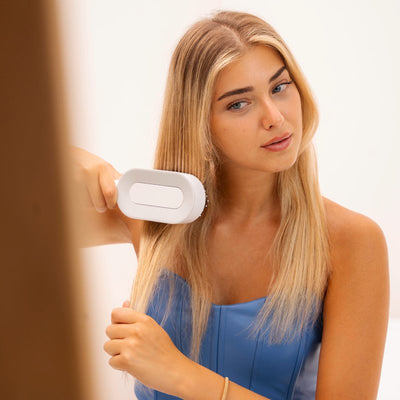
Self-Cleaning Hair Brush
Flexible bristles work with the Lebanese hair cuticle direction rather than against it — smoothing rather than lifting. One-press self-cleaning maintains consistently low friction that keeps cuticle disruption minimal on every session.
Shop Now →
The most widely ignored step in Lebanese hair styling — and one of the most impactful for frizz reduction. Lebanese women who touch, toss, or separate curls before they are fully cool are physically recreating the frizz their tools just removed.
The science
When heat styling, the hydrogen bonds that give Lebanese hair its shape are broken and then reformed around the new shape as the hair cools. The bonds are not fully reformed until the hair reaches room temperature — which takes a full 60–90 seconds after the tool is removed. Touching, separating, or tossing Lebanese hair before it cools interrupts the bond reformation mid-process, locking in a partially reformed — and frizzy — structure rather than the smooth aligned structure that would have set if cooling had been allowed to complete.
The action
After releasing each curl from the barrel, hold it in your palm for a 15-second count before releasing. After the full head is done, wait a minimum of 3 minutes before touching or separating — run a timer if needed. Do not toss, shake, or run fingers through until all sections are completely at room temperature. The Supercoat goes on after this cooling period — not during it.
Beirut Humidity Levels — When to Apply Supercoat and How Much
30–50%
Low (Beirut winter)
1 light Supercoat pass · Frizz risk low
50–65%
Moderate (spring)
2 light Supercoat passes · Standard protection
65–80%
High (summer June–Jul)
2–3 passes · Reapply midday outdoors
80–90%+
Peak (Aug–Sep coastal)
3 passes · Reapply every 4 hrs outdoors · Maximum protection mode
The Daily Frizz-Free Checklist for Lebanese Hair
1
Before styling: Apply Argan Oil to every section — 3–4 sprays on thick Lebanese hair. Wait 30–60 seconds.
2
During styling: Hold each curl 15 seconds in palm before releasing. Do not touch the full head for 3 minutes after last section.
3
After styling: Apply Supercoat — 2–3 passes based on today's humidity. Before the AC vent. Before the window. Before the door.
4
Outdoors at peak humidity: Carry Supercoat. Reapply every 4 hours in Beirut August–September outdoor conditions.
5
Before sleep: Satin Scrunchie — loose pineapple or low bun. Every night. Stops overnight cuticle disruption from cotton friction.
6
Weekly: Overnight Argan Oil treatment on dry hair. Restores the internal moisture that reduces frizz reactivity from the inside out.
Lebanese Women on Going Frizz-Free
★★★★★
"I have had frizzy hair my entire life and accepted it as just how my hair is. The Supercoat before going outside — not after the frizz starts — was the specific change that made everything different. My hair holds in Beirut August now. I never thought that was possible."
— Joelle, Beirut
★★★★★
"The cooling before touching tip was so simple and so impactful. I used to shake my curls out immediately after the barrel. One week of waiting 3 minutes and my frizz reduced dramatically without any other change."
— Hiba, Jounieh
★★★★★
"After 4 weekly Argan Oil treatments my hair is just less reactive to humidity overall. My morning hair is better even on non-styling days. The internal moisture is what was missing — I was only ever treating the surface."
— Nour, Batroun
Frizz is not your hair type. It is a solvable problem. The complete Nasmati frizz-free system — Supercoat, Argan Oil, ceramic tools, Satin Scrunchies, Self-Cleaning Brush — free express shipping across Lebanon. 12-month warranty on every tool.
Shop the Full Nasmati Collection →
Identify your frizz type — try the free AI Hair Analyzer →