Hair tool damage in Lebanon is almost always invisible until it becomes severe. The cuticle does not send a notification when it cracks. The cortex does not announce when its protein structure changes. The damage accumulates quietly — session by session, week by week — until Lebanese women describe the same experience: hair that was fine for years and then suddenly seemed to deteriorate overnight. It was not overnight. These are the five warning signs that appear before the severe stage, what each one means, and the exact fix for each one.
Hair Tool Damage Guide · Lebanon · 2026
The damage is not sudden. It accumulates invisibly — until these signs appear.
Lebanese women who recognize any of these signs are not past the point of recovery — they are at the inflection point where intervention makes the most difference. The earlier these signs are addressed, the less damage compounds. Every sign on this list has a specific, fixable cause. None of them are simply "how your hair is."
The 5 Signs — What They Mean and How to Fix Each One
Each sign points to a specific damage mechanism. Treating them generically — with "more conditioner" or "less heat" — fails because the cause is more precise than the generic solution.
A style that looked perfect leaving the house and collapses completely before lunch is not a technique problem — it is a cuticle problem. Lebanese women who experience this consistently are dealing with one or more of three specific issues, and styling harder or using more product does not resolve any of them.
Self-Test
Does your style hold indoors but collapse quickly once you step outside?
If yes: this is unsealed cuticle + humidity frizz. If your style falls even indoors within an hour: this is a setting problem — the style was never fully formed due to incorrect technique, wrong temperature, or sections too large for thick Lebanese hair.
What is actually happening
Heat styling works by breaking hydrogen bonds in hair and reforming them around the new shape. For the new shape to hold, two things must happen: the bonds must fully reform before the curl is released (requires a 15-second palm hold after the barrel), and the cuticle must be sealed closed before humidity exposure (requires a sealing product applied immediately after styling). If either step is skipped, Beirut's humidity enters the open cuticle and reforms new hydrogen bonds in the original hair shape — collapsing the style from the inside.
The fix
Two changes simultaneously: (1) Hold each curl in your palm for a full 15-second count after releasing from the barrel before letting it fall — this is when bonds fully reform. (2) Apply Nasmati Supercoat to all sections immediately after styling, before any outdoor exposure. Both changes are required. Either alone produces partial results on Lebanese hair.
The Fix
Supernatural Anti-Frizz Humidity-Proof Supercoat
Seals the cuticle closed after styling — blocking Beirut's humidity from entering and collapsing the style. Apply after every session, before leaving the house.
Shop Now →
Curls that hold on the left side but fall on the right. Smooth sections next to frizzy ones. Shiny areas and dull areas on hair that received identical styling passes. This inconsistency is almost always a tool problem — not a technique problem — and it gets worse the older the tool gets.
Self-Test
Run your fingers along a styled section immediately after the tool passes through. Do some areas feel noticeably dryer or rougher than others?
If yes: your tool has hot spots — areas of the plate or barrel exceeding the stated temperature by 15–30°C. These contact zones cause localized overheating that produces the inconsistency you see in your finished style.
What is actually happening
Metal and worn tourmaline-coated tools develop hot spots — localized zones where electrical resistance is slightly higher, generating more heat than surrounding areas. These zones permanently lift cuticle scales at their contact points, creating a rough surface that scatters light (dullness) and absorbs humidity faster (frizz) than the intact cuticle zones on the same section. The inconsistency between sections is not random — it maps directly to which part of the barrel's hot spot contacted which strands. Cheap tools start with hot spots. Any tool with a coating starts developing more as the coating wears away.
The fix
Replace the tool with full ceramic construction. No coating to wear away. No hot spots. Uniform heat across every contact point with every section of Lebanese hair. This is not about brand preference — it is physics. Ceramic's thermal properties eliminate the electrical resistance variation that creates hot spots in metal tools entirely.
The Fix
5-in-1 Magic Hair Curler — Full Ceramic
Zero hot spots across all five barrel sizes — CE and FCC certified for consistent thermal performance. Every section of thick Lebanese hair receives identical heat on every pass.
Shop Now →
Hair should feel softer and smoother immediately after a styling session than it did before. If Lebanese women find their hair feels dryer, rougher, or more brittle right after styling — the tool is removing more moisture than the style is worth. This is one of the clearest early warning signs of cumulative tool damage.
Self-Test
Touch a section of your hair before and after a styling pass with your current tool. Does it feel softer after the pass — or drier?
Ceramic tools on protected hair should produce sections that feel smoother after the pass. Metal tools, unprotected styling, or tools running significantly hotter than their stated temperature produce sections that feel noticeably drier — the moisture evaporation is happening in real time and you can feel it.
What is actually happening
Healthy hair holds 8–15% water content. Every heat styling session removes some of this moisture through evaporation. Metal tools remove 18–22% per session through direct evaporation at hot spot zones. Ceramic tools with heat protectant remove 6–9%. The difference compounds over every weekly session. Lebanese women who have been styling without heat protectant on metal tools for a year have hair running at 3–5% water content — below the brittleness threshold where strands snap under minimal stress rather than flex.
The fix — two steps simultaneously
Immediate: Apply Argan Oil Heat Protectant to every section before every heat tool use from today. No exceptions. This reduces per-session moisture depletion immediately. Restoration: Begin weekly Argan Oil deep treatments on dry hair — leave 30 minutes minimum, overnight before wash day for best results. This restores cortex moisture that past damage has depleted. Both steps are needed — protection stops new depletion, weekly treatment restores the deficit.
The Fix
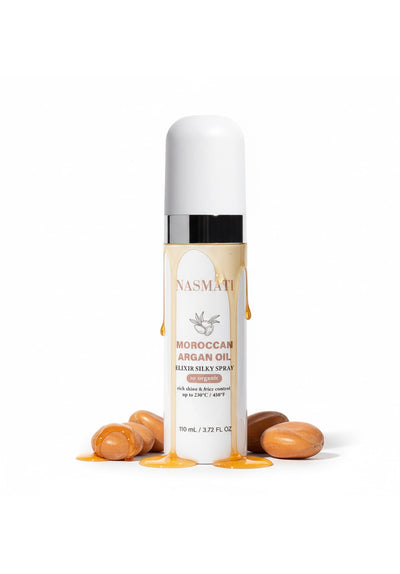
Moroccan Argan Oil Heat Protectant Spray
Reduces per-session moisture loss from 18–22% to 6–9% immediately. Used weekly as a standalone deep treatment, it penetrates the cortex to restore the structural moisture deficit that months of tool damage has created.
Shop Now →
Finding short broken hairs around the hairline, in your brush, and across your shoulders after styling is not normal shedding — it is breakage. Natural hair shedding produces full-length hairs with a white root bulb. Breakage produces short, tapered hairs with no bulb. If Lebanese women are seeing more of the latter, their tools or technique are causing it.
Self-Test
Examine the hairs in your brush after detangling. Are they full length with a white bulb at the root — or short, snapped pieces?
Full length + white bulb = natural shedding (normal, 50–100 per day). Short + tapered ends = breakage from mechanical or heat damage. If the majority are short snapped pieces, you have a breakage problem — not a shedding problem — and the cause is almost always tool-related.
What is actually happening
Hair breakage from tools happens through two mechanisms: thermal brittleness — moisture depletion from heat makes strands snap under the mechanical stress of brushing and styling rather than flexing — and mechanical abrasion — stiff bristles, clogged brushes, and aggressive detangling concentrate tension at single points on the strand rather than distributing it across the section, snapping the strand at its weakest point. Both produce the short broken hairs Lebanese women find increasing around their styling routine.
The fix
For thermal breakage: Start weekly Argan Oil deep treatments immediately and apply heat protectant before every session — rebuilding moisture levels reduces brittleness within 3–4 weeks. For mechanical breakage: Always detangle ends first and work upward in small sections — never root to tip in one stroke. Clean your brush after every single use — accumulated hair in bristles triples friction on thick Lebanese hair with every stroke.
The Fix
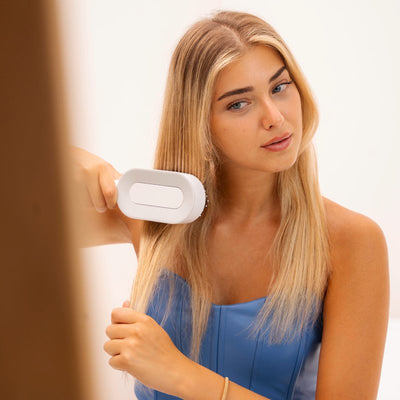
Self-Cleaning Hair Brush
Flexible bristles distribute detangling tension across thick Lebanese hair rather than concentrating it at snap points. One-press self-cleaning removes accumulated hair instantly — keeping friction consistent and low with every brushing session.
Shop Now →
Lebanese women who find themselves gradually increasing the temperature on their tools — 160°C became 175°C, which became 190°C, which is now at maximum — to achieve the same curls or straight style they used to get at lower temperatures are experiencing one of the most dangerous progressive damage patterns in hair tool use. The tool is not losing power. The hair is being conditioned to require more heat to respond.
Self-Test
What temperature were you using on your tools 12 months ago versus today for the same style?
If your required temperature has increased by more than 10–15°C over 12 months without a change in hair type: your hair has developed increased porosity from cumulative damage, is losing styles faster due to structural weakness, and is requiring more heat to compensate — which accelerates the damage cycle further.
What is actually happening
Cumulative heat damage creates a progressive porosity increase in the hair shaft. Porous hair — with its lifted, damaged cuticle — absorbs heat faster but also loses moisture faster, meaning it requires more heat to reach the cortex temperature needed to reshape hydrogen bonds AND holds the style for less time once set. This creates a self-reinforcing cycle: more damage → more porosity → more heat needed → more damage. Lebanese women who recognize this sign are at the point where breaking the cycle with the right tools and protectant makes the most dramatic improvement.
The fix — break the escalation cycle
Stop the cycle immediately: Apply Argan Oil before every session and begin weekly deep treatments. As cortex moisture is restored over 4–8 weeks, the hair becomes less porous and responds better to lower temperatures. Switch to full ceramic tools — their even heat distribution means less total temperature is needed to achieve the same styling result on porous hair, because the heat reaches every strand uniformly rather than requiring compensation for unheated zones.
The Fix
Cordless Comb Hair Straightener — Full Ceramic
Even ceramic heat reaches every strand uniformly — requiring lower temperature to achieve the same styling result than metal tools that leave cold zones requiring heat compensation. As Lebanese hair restores from weekly Argan Oil treatments, the required temperature decreases rather than escalates.
Shop Now →
Your Action Plan — If You Recognized Any of These Signs
Today
Stop using any heat tool without Argan Oil protectant applied first. This is the single highest-impact change and it costs nothing extra — just a different order of steps in your routine.
This week
Do one Argan Oil deep treatment on dry hair. Apply generously, leave 30 minutes minimum. This begins restoring the cortex moisture deficit that is amplifying every sign on this list.
After styling
Apply Supercoat before every outdoor exposure. Sealing the cuticle after styling addresses Sign 1 immediately — and makes every other step in your routine last longer.
If tool is old
Check your tool for hot spots using the Sign 2 self-test. If sections feel inconsistently dry after passes, the coating has degraded. A deteriorating tool is more damaging than a new cheap tool — replacement is the only solution.
Long term
Switch to full ceramic construction. Nasmati's certified ceramic tools address Signs 2, 3, and 5 structurally — not temporarily. The investment recovers in the first few months of not replacing cheap deteriorating tools.
Lebanese Women Who Recognized These Signs
★★★★★
"Sign 2 was exactly my problem — some sections always looked different from others. I thought it was my technique for two years. It was the hot spots on my old tool the entire time. The moment I switched to the Nasmati ceramic curler it was completely even."
— Tala, Beirut
★★★★★
"I was at maximum heat on my old straightener and styles were still falling. I started the Argan Oil treatment weekly and switched tools — within a month my hair was responding at lower temperatures than it had in years."
— Leen, Jounieh
★★★★★
"The breakage test was eye-opening. I checked my brush and everything was short snapped pieces — not full hairs. The ends-first brushing technique with the self-cleaning brush reduced the breakage visibly within two weeks."
— Hind, Tripoli
None of these signs are permanent. Every one of them has a specific, fixable cause — and the earlier they are addressed, the less damage compounds. The complete Nasmati solution — ceramic tools, Argan Oil, Supercoat, Self-Cleaning Brush — free express shipping across Lebanon. 12-month warranty on every tool.
Shop the Full Nasmati Collection →
Find out which tools your hair needs — try the free AI Hair Analyzer →