A Lebanese woman spending $40–$80 at a salon every week to get her hair looking right is not a luxury — it is a necessity, because nobody ever showed her how to achieve the same result herself. The difference between a salon blowout and a home styling attempt is almost never the tools. It is the technique, the order of steps, and knowing what thick Lebanese hair needs specifically. This guide gives you everything the stylist knows — step by step, style by style — so you never have to book that appointment just to look presentable again.
The real reason salon hair looks different — and it is not the price of the tools.
Professional stylists work in a specific sequence: prep → protect → section → apply heat correctly → seal → finish. Most women at home skip 3 of these 6 steps, apply heat incorrectly on the 4th, and wonder why the result doesn't hold. This guide covers every step in the exact order that makes Lebanese hair — thick, frizzy, and humidity-exposed — look polished for 2–3 days from a single styling session.
Part 1 — The Foundation (Before Any Heat Tool Touches Your Hair)
The 3 steps most Lebanese women skip that account for 70% of the difference between home and salon results.
The single most common home styling mistake Lebanese women make: starting to curl or straighten hair that is still significantly wet. Professional stylists always rough-dry hair to 85–90% dry before any styling tool is used — for very specific science-backed reasons.
💡
Why this matters for Lebanese hair: Wet hair is 40% weaker than dry hair. Applying a hot barrel to wet Lebanese hair causes steam to form inside the hair shaft — the same process as boiling an egg. This steam damages the cortex from inside out. Allow hair to air dry naturally to 85% before any heat tool, or rough dry with cool air from a hair dryer first.
Common mistake to avoid
Towel-rubbing Lebanese hair aggressively after washing. Instead, squeeze excess water out with your hands, then press (don't rub) with a microfiber towel or an old T-shirt. The rubbing motion lifts and breaks cuticle scales on thick wet hair.
Lebanese women who use heat protectant at all typically spray it on the ends. Stylists apply it to every section from root to tip before any heat is used — and there is a technique to doing it correctly.
💡
The pro application technique: Divide hair into 4 sections before applying protectant. Hold each section away from the scalp and spray 2–3 times from 15–20cm away. Run fingers through each section to distribute evenly. The goal is a light, even coat on every strand — not a saturated section and untouched sections.
Nasmati Tool
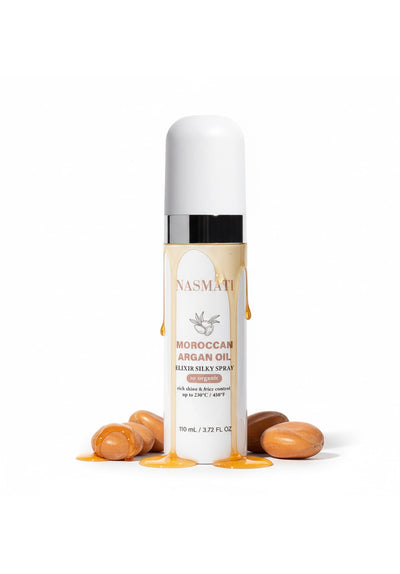
Moroccan Argan Oil Heat Protectant Spray
Shields Lebanese hair up to 230°C. The lightweight mist formula distributes evenly without weighing thick hair down — so every section gets full protection without feeling coated or heavy.
Shop Now →
Every professional stylist sections thick hair before touching it with a tool. Almost no Lebanese woman does this at home — and it is the single biggest difference between a result that holds all day versus one that looks good for 20 minutes and falls apart.
💡
The 4-section rule for Lebanese hair: Divide into bottom nape section, middle section, and two top sections (left and right crown). Always style bottom sections first, work upward. For very thick Lebanese hair, divide each section into 2 — giving you 8 sections total. Smaller sections = more even heat distribution = longer lasting results.
💡
Why this matters specifically: Styling thick Lebanese hair in large sections means the interior strands never fully receive the heat — the outer layer gets over-processed while the inside remains unstyled. This creates styles that look good immediately but fall flat within an hour as the inner unstyled hair asserts itself.
Nasmati Tool
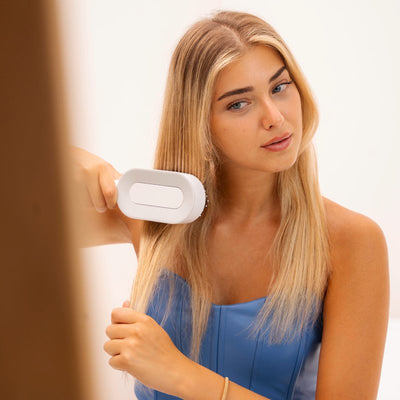
Self-Cleaning Hair Brush
Detangle each section fully before clipping it up — styling over tangles means uneven heat application and inconsistent results. The self-cleaning mechanism keeps bristles clear so your detangling stays effective on every section.
Shop Now →
Part 2 — Style-by-Style Technique Guides for Lebanese Hair
The exact technique for each look — adapted for thick, frizzy Lebanese hair in a humid climate.
-
Set your curler to 175–185°C for medium Lebanese hair, 185–195°C for thick. Always use heat protectant first.
-
Take sections no wider than your barrel diameter — for thick Lebanese hair this means thinner sections than you think. A section too wide = curl won't hold.
-
Wrap each section around the barrel, holding for 8–10 seconds (thick hair), 6–8 seconds (medium). Count it — don't guess.
-
The most important step: Release the curl and hold it in your palm for 10–15 full seconds before letting it fall. This is when the hydrogen bonds reform around the curl shape. Skip this and the curl drops within an hour.
-
Work bottom to top. Leave the crown section for last — it holds heat longer and needs less time than bottom sections.
-
Curl alternate sections in opposite directions for the most natural, voluminous result on thick Lebanese hair.
-
Once all curls are set and cooled, run fingers through lightly to separate — do not brush. Apply Supercoat immediately to seal.
Nasmati Tool
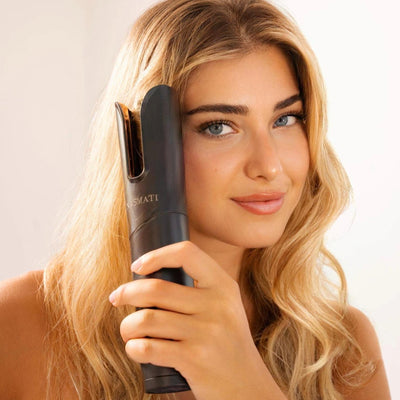
5-in-1 Magic Hair Curler
Five barrel sizes mean you have the right diameter for every curl type your Lebanese hair needs — from tight defined ringlets to loose beach waves. Ceramic coating ensures even heat across thick sections, so every curl sets in the same number of seconds.
Shop Now →
✓ Expected result: Curls that hold for 24–48 hours in Lebanese humidity when sealed with Supercoat immediately after styling.
-
Set straightener to 175°C for medium hair, 185–190°C for thick. Higher is almost never needed and causes unnecessary protein damage.
-
Section bottom first. Take sections 2–3cm wide maximum for thick Lebanese hair — larger sections = more passes needed = more heat.
-
Clamp at the root (not at the scalp — leave 1cm gap), and glide slowly down the full length in one continuous smooth motion. Stopping and starting creates creases.
-
Each section should take one pass at the correct temperature — not multiple passes. If it needs a second pass, your sections are too thick.
-
For Lebanese hair prone to frizz at the hairline: use a comb straightener on the front sections — the comb teeth detangle as they straighten, eliminating the need for repeated passes on these fine, visible strands.
-
Seal with Supercoat immediately after completing all sections. This is what holds straight hair straight in Beirut humidity.
Nasmati Tool
Cordless Comb Hair Straightener
Straightens and detangles in a single pass — eliminating the need to pre-detangle and then straighten separately. Fully cordless so you can move freely around your head without the restricted reach that forces extra passes.
Shop Now →
✓ Expected result: Smooth, straight hair that holds through a full day in Lebanese humidity when sealed immediately after styling.
-
Use your largest barrel for beach waves on thick Lebanese hair. The bigger the barrel, the looser and more natural the wave.
-
Leave the last 2–3cm of each section uncurled — the untouched ends give waves their natural, undone look that separates beach waves from formal curls.
-
Alternate curl direction on every section: wrap one section toward your face, the next away. This is the difference between natural waves and a uniform curl pattern.
-
Hold each section on the barrel for only 5–7 seconds for a soft wave — less time than formal curls. Over-curling kills the effortless look.
-
After all sections cool, shake hair gently from the roots — don't use your hands or a brush. The shake technique separates Lebanese waves without disrupting them.
-
Apply Supercoat with fingers, scrunching lightly upward — this seals the wave shape while maintaining the soft texture.
Nasmati Tool
Cordless Hair Curler Pro
Cordless freedom lets you wrap sections naturally from any angle — critical for the alternating direction technique that creates authentic beach waves. Adjustable heat means you can drop to 165°C for a softer, more natural wave on fine Lebanese strands.
Shop Now →
✓ Expected result: Soft, natural-looking waves that hold for 2 days in Lebanese weather when sealed with Supercoat immediately after styling.
Part 3 — The Finishing Steps That Make Lebanese Hair Last
The steps that separate a style that lasts 2 hours from one that lasts 2 days.
After all heat styling is complete, apply a humidity barrier product before stepping outside or near any open window. In Lebanon — especially in summer — this step separates a style that lasts 3 hours from one that lasts 2 days. Most women think this is an optional finishing product. It is not. It is structural maintenance for the style.
💡
The correct application method: Hold the Supercoat 20–25cm from hair, spray in 2–3 light, even passes from roots to ends. Do not saturate — a light even coat is what seals. Applying too heavily weighs Lebanese thick hair down and eliminates the volume you just created.
Nasmati Tool
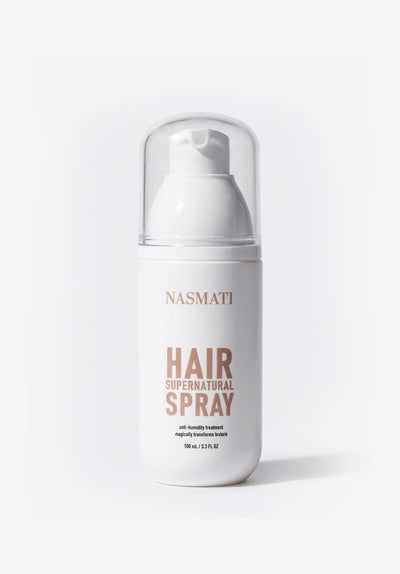
Supernatural Anti-Frizz Humidity-Proof Supercoat
Creates a humidity-proof barrier that seals the cuticle closed and locks the style in place — designed specifically for Lebanon's coastal and mountain humidity. The last step of every styling routine and the one that determines how long everything else holds.
Shop Now →
A Monday morning salon-quality style should still look like it on Tuesday. The way Lebanese women sleep determines whether it does. Cotton pillowcases create friction that destroys styled hair overnight — especially curls and waves.
💡
The overnight technique for each style: Curls: loosely gather all hair at the top of your head ("pineapple") and secure with a satin scrunchie — no tension, just enough to keep hair off the pillow. Waves: same pineapple technique. Straight: loose low bun at the nape of your neck with a satin scrunchie. This preserves your style and keeps humidity from disrupting it while you sleep.
Nasmati Tool
Satin Crystal Scrunchies
Satin creates minimal friction against Lebanese hair's cuticle — securing your style overnight without the abrasion and compression that cotton elastics cause. The difference in next-morning hair quality is visible within 3–4 nights of switching.
Shop Now →
The Complete Lebanese Hair Styling Routine — Time Breakdown
Prep
Towel-press (no rubbing) → air dry to 85% or rough dry with cool air. Time: 15–20 min air dry
Step 1
Section hair into 4–8 sections using clips. Detangle each section with Self-Cleaning Brush before clipping. Time: 3–4 min
Step 2
Apply Argan Oil Protectant to each section — 2–3 sprays each, distributed with fingers. Time: 2–3 min
Step 3
Style each section bottom to top, using correct temperature for your hair type. Hold each curl 10–15 sec before releasing. Time: 15–25 min
Step 4
Let all sections cool completely (2–3 min). Do not touch or style further while warm. Time: 2–3 min
Step 5
Apply Supercoat in 2–3 light passes before any humidity exposure. This locks everything in. Time: 1 min
Night
Pineapple or low bun with Satin Scrunchie before bed. Preserves style for day 2. Time: 30 seconds
The Lebanese salon experience is not magic — it is a sequence of steps done in the right order with the right tools. Now you have the exact sequence. Every product you need is available at nasmaticare.com with free express shipping across Lebanon. 12-month warranty on every tool.
Shop the Full Nasmati Collection →
Don't know your hair type yet? The free Nasmati AI Hair Analyzer tells you in 10 seconds — including which tools are matched to your results.