Lebanese women ask this question constantly — and the answer almost always surprises them. Hair does not grow slowly. The average human scalp grows 1–1.5cm of new hair every month without exception. The reason Lebanese hair feels stuck at the same length for years is not slow growth — it is breakage. Every centimeter growing from the root is being lost at the ends through heat damage, mechanical stress, and the specific environmental conditions Lebanon creates for hair. This guide explains the complete science of hair growth and retention — and the exact habits and tools that let Lebanese hair reach its real potential length.
Hair Growth Science · Lebanon
Your hair is already growing 12–18cm per year. The goal is to stop losing it.
1–1.5cmAverage monthly hair growth
12–18cmAnnual growth potential
~6 yrsAverage hair growth cycle length
90%Of length issues caused by breakage not growth
The most important truth about Lebanese hair growth
Lebanese hair grows at the same rate as hair anywhere else in the world — 1 to 1.5 centimeters per month. The reason most Lebanese women feel their hair "won't grow" is that they are losing length at the ends faster than they are gaining it at the root. Heat damage, brushing breakage, cotton pillowcase friction, hard tap water buildup, and Beirut's humidity-driven frizz cycle are all removing length continuously. Fix the breakage — and length retention becomes automatic.
8 Habits That Let Lebanese Hair Reach Its Full Growth Potential
In order of impact — from the changes that produce the fastest visible results to the long-term habits that sustain them.
The single fastest-acting length retention habit Lebanese women can adopt — and the one that requires zero skill, zero technique change, and 30 seconds per night. Most Lebanese women are losing significant length in their sleep every single night through cotton pillowcase friction, and have been for years.
The science
Cotton pillowcases create friction that abrades the hair cuticle during 8 hours of sleep movement. For thick Lebanese hair, which has more strands creating more friction contact per movement, this overnight abrasion causes significant cuticle lifting and strand breakage that accumulates into visible end-thinning over months. Switching to satin reduces overnight friction by up to 43% — immediately reducing the nightly breakage rate that has been silently removing length for years.
The action
Secure hair in a loose pineapple (for curly/wavy Lebanese hair) or loose low bun (for straight/thick Lebanese hair) with a Nasmati Satin Scrunchie before every sleep. This keeps most hair off the pillow surface and what does contact it slides rather than catches. Start tonight — results are visible in morning hair quality within 3–4 nights.
Start Here Tonight
Satin Crystal Scrunchies
The highest return-on-investment hair growth habit for Lebanese women — zero effort, zero technique, and immediate reduction in the overnight breakage that has been removing length for years.
Shop Now →
Heat styling removes 18–22% of hair's moisture per session on unprotected hair. As moisture depletes below the brittleness threshold, strands snap rather than flex — removing length from the ends with every styling session. Lebanese women who style daily without protection are actively removing the length their hair is trying to grow.
The science
Hair's tensile strength — its ability to stretch without breaking — is directly dependent on moisture content. Hair with 8–15% water content stretches up to 30% before breaking. Hair with under 6% moisture (common in Lebanese women who style daily without protection) snaps at minimal stress. Each heat protectant application reduces per-session moisture loss from 18–22% to 6–9% — meaning protected Lebanese hair retains 2–3× more moisture per styling session, staying above the brittleness threshold for significantly longer.
The action
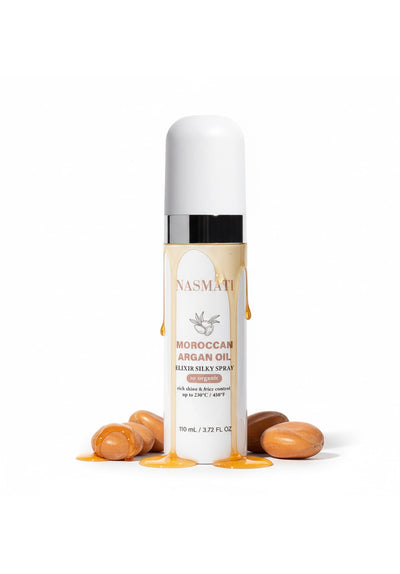
3–4 sprays of Argan Oil Heat Protectant on every section, root to tip, before any heat tool. Not just on styling days — on any day a heat tool is used, even for a quick touch-up. Also use the Argan Oil weekly as a standalone deep treatment on dry hair — 30 minutes minimum, overnight before wash day for best results.
Daily + Weekly Use
Moroccan Argan Oil Heat Protectant Spray
Reduces per-session moisture loss by 60% daily AND penetrates the cortex as a weekly deep treatment to restore the structural moisture that determines whether Lebanese hair retains length or breaks it off.
Shop Now →
Brushing thick Lebanese hair root-to-tip in one stroke is one of the most common and most damaging length-removal habits Lebanese women have — and it feels completely normal because it is how most women were taught to brush. The damage is invisible per session but accumulates into the end-breakage that makes Lebanese hair feel like it "won't grow past a certain length."
The science
Root-to-tip brushing forces the bristles through knots rather than releasing them progressively. The tension concentrates at the knot point — which is almost always in the mid-shaft or ends — and exceeds the hair's tensile strength at that point, snapping the strand. For thick Lebanese hair, this happens to hundreds of strands per brushing session. Ends-first detangling releases each knot from the bottom up, distributing tension across the full section rather than concentrating it at a single snap point.
The action
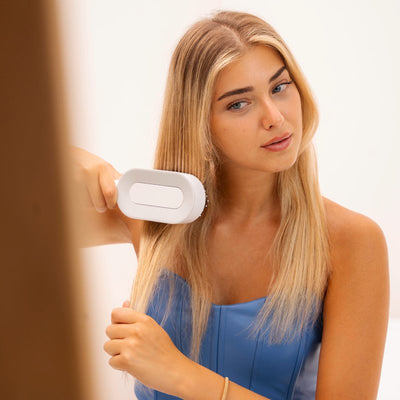
Always begin brushing at the ends — take the bottom 5cm and work through any knots there first. Move up 5cm. Repeat until you reach the roots. Never force the brush through resistance — if it catches, work the knot out with fingers first. Apply 1–2 sprays of Argan Oil before detangling on thick or tangled Lebanese hair for slip that reduces friction further.
Daily Use
Self-Cleaning Hair Brush
Flexible bristles distribute detangling tension across thick Lebanese hair rather than concentrating it at snap points. Self-cleans after every use — accumulated hair in bristles triples friction and breakage on subsequent sessions. Clean bristles every time.
Shop Now →
Most Lebanese women style at the same temperature regardless of what their hair actually needs — usually maximum heat by default. Every degree above the minimum effective temperature accelerates the cumulative damage that removes length over time. This is the slowest-to-notice but most impactful long-term habit change for Lebanese hair length retention.
The science
Hair's keratin proteins begin denaturing above 150°C — a permanent structural change that cannot be reversed. Each degree above the minimum effective temperature increases the rate of keratin denaturation exponentially. Lebanese women who style thick hair at 210°C are causing 3–4× more protein damage per session than they would at 185°C for the same result. With ceramic tools that distribute heat evenly, thick Lebanese hair typically styles effectively at 175–190°C — 20–30°C lower than the maximum most women use by default.
The action
Drop your styling temperature by 15°C from whatever you currently use. Try one week at the lower setting — with ceramic tools you will likely achieve the same result. Fine Lebanese hair: 145–160°C. Medium: 160–175°C. Thick: 175–190°C. Never use maximum heat by default — start lower and only increase if needed.
Precise Temperature Control
5-in-1 Magic Hair Curler
Adjustable 150–200°C with full ceramic distribution — achieves the same styling result at 15–20°C lower than metal tools require, because even heat reaches every strand rather than requiring temperature compensation for cold spots.
Shop Now →
The elastic hair tie is one of the most underestimated causes of chronic length loss for Lebanese women. It is used multiple times per day, every day, year after year — and every single use creates concentrated mechanical stress at exactly one point on the hair shaft, at the same location, repeatedly.
The science
Elastic ties catch on the hair cuticle and create a high-stress wrap point — the same location on the strand, every time the tie is used. This causes a specific and well-documented breakage pattern called traction damage at the ponytail line. For thick Lebanese hair, which requires the elastic to be wrapped tighter to hold, this stress is amplified. Switching to satin distributes hold across a wider surface area and eliminates the cuticle-catching that creates the concentrated snap point.
The action
Replace every elastic in your house, bag, and bathroom with Nasmati Satin Scrunchies. Do not keep elastics as "backup" — if they are accessible you will use them. Vary your ponytail position daily so the same point on your hair shaft is not compressed repeatedly. Never pull an elastic straight out — always slide it off slowly.
Lebanese women who style with heat 5–7 days per week accumulate thermal damage significantly faster than women who style 3–4 days per week. The hair has no recovery period — and damage accumulates faster than the weekly Argan Oil treatment can restore. Heat-free days are not about style sacrifice — they are about giving the restoration cycle time to work.
The science
Hair restoration from Argan Oil deep treatments happens during the 48–72 hours after application — the argan oil molecules penetrate the cortex progressively over this period. If heat styling is applied within this window, the thermal exposure disrupts the restoration process before it completes. Two or three heat-free days per week gives the cortex time to fully benefit from each weekly treatment — producing visibly healthier, stronger hair within 4–6 weeks.
The action
Target 2–3 heat-free days per week. On these days: apply Argan Oil to damp hair after washing, air-dry, and seal with Supercoat to control Beirut's humidity on the natural texture. The enhanced natural texture look (Habit 7 in this guide) is how Lebanese women make heat-free days look intentional rather than lazy.
Heat-Free Day Essential
Supernatural Anti-Frizz Humidity-Proof Supercoat
On heat-free days in Lebanon, Supercoat is the product that makes the difference between natural texture that looks intentional and natural texture that looks neglected — sealing the air-dried result against Beirut's humidity.
Shop Now →
Metal tools with hot spots cause localized overheating at specific contact zones — permanently lifting cuticle scales and weakening the strand at those exact points. Over months of weekly use, these weakened zones become the break points that remove length from the ends. Switching to full ceramic eliminates hot spots entirely.
The science
A metal curler or straightener set to 180°C can have hot spots reaching 210°C at points of uneven electrical resistance. These hot spots permanently lift cuticle scales and weaken keratin bonds at their contact points with every single use. Over 52 weekly sessions per year, the cumulative hot-spot damage on thick Lebanese hair creates dozens of structural weak points in the end sections — which break off progressively, keeping length apparently "stuck" despite continuous growth from the root.
The action
Replace any metal or worn tourmaline-coated tools with full ceramic alternatives. Check your current tools: run your fingers along a styled section immediately after a pass — if some areas feel noticeably dryer or rougher than others, your tool has hot spots. Full ceramic tools feel identical across every contact point.
Full Ceramic — No Hot Spots
Cordless Comb Hair Straightener
Full ceramic construction eliminates hot spots entirely — every contact point delivers identical, consistent heat to thick Lebanese hair. No localized overheating. No weakened break-point zones accumulating in the ends session by session.
Shop Now →
All the breakage-prevention habits in this guide are more effective when the hair's structural moisture is restored. The weekly deep treatment is the foundation — without it, the hair runs a chronic moisture deficit that makes it more vulnerable to every other breakage source simultaneously.
The science
Argan oil's oleic and linoleic fatty acids have a molecular size small enough to penetrate the hair cuticle and reach the cortex — unlike regular conditioner, which coats the surface only. Weekly cortex penetration restores the internal water-binding capacity of thick Lebanese hair — increasing its moisture retention between sessions and reducing the brittleness that allows every other breakage mechanism to do more damage. It is the multiplier that makes every other habit in this list more effective.
The weekly routine
Night before wash day: Apply Argan Oil generously to completely dry hair, roots to ends. Leave overnight. Wash out in the morning. This 30-second pre-bed application takes no time and produces more cortex moisture restoration than any in-shower conditioning treatment because penetration time is unlimited.
3 Hair Growth Myths Lebanese Women Still Believe
Common beliefs that waste time and sometimes cause more damage than they prevent.
⚠ Myth 01
Cutting your hair makes it grow faster
Hair grows from the follicle at the scalp — not from the ends. Cutting the ends has zero effect on the growth rate at the root. Regular trims do help retain length by removing split ends before they travel up the shaft and cause more extensive breakage — but this is length retention, not growth acceleration. The two are often confused.
⚠ Myth 02
Brushing 100 times a day stimulates growth
Excessive brushing distributes scalp oils and improves circulation slightly — but 100 strokes per day causes far more mechanical breakage than any circulation benefit justifies. Lebanese women with thick hair who brush excessively are removing length faster than any growth stimulus can compensate. Brush once daily, ends first, with clean flexible bristles. That is sufficient.
⚠ Myth 03
Arabic and Lebanese hair grows slower than other hair types
False — there is no evidence that Arab hair grows at a different rate than any other ethnicity. All human hair grows 1–1.5cm per month on average. Lebanese women whose hair appears to grow slowly are experiencing breakage at the ends that offsets the growth at the root — the net length change appears to be zero. Fix the breakage and the hair grows at its full natural rate immediately.
What to Expect — Realistic Lebanese Hair Growth Timeline
Week 1–2
Overnight friction reduced immediately with Satin Scrunchie. Morning hair quality improves noticeably within 3–4 nights.
Week 3–4
Breakage reduction becomes visible in the brush — fewer short snapped pieces, more full-length natural shedding hairs. Ends feel less rough after 3–4 weekly Argan Oil treatments.
Month 2
Net length gain becomes measurable. With breakage significantly reduced and 1–1.5cm of new growth per month continuing, length that previously seemed stuck begins accumulating visibly for the first time.
Month 3–4
Texture and strength improvements visible throughout. Lebanese hair that has been on the full routine for 3–4 months typically shows 3–4cm of retained length — the same growth that was previously lost to breakage now actually remaining on the head.
Month 6+
Full growth potential being realized. 6–9cm of retained new length versus the near-zero net gain most Lebanese women experience before addressing breakage. Hair condition continues improving as the cumulative damage deficit is progressively restored.
Lebanese Women on Hair Growth With Nasmati
★★★★★
"My hair has been the same length for 4 years. Three months after starting the Argan Oil treatment weekly and sleeping with the satin scrunchie — I have genuinely gained length for the first time. I cannot believe it was that straightforward."
— Lara, Beirut
★★★★★
"The ends-first brushing tip seems so simple but I checked my brush after switching — completely different. So many fewer broken hairs. My ends look thicker than they have in years after 6 weeks of the new technique."
— Hiba, Jounieh
★★★★★
"I was convinced Lebanese hair just doesn't grow. The guide made me realize I was losing it faster than I was growing it. Fixed the breakage and my hair is finally past my shoulders after 5 months."
— Nadia, Tripoli
Your hair is already growing. Stop losing it. The complete Nasmati length retention system — Argan Oil, Satin Scrunchies, Supercoat, ceramic tools, Self-Cleaning Brush — free express shipping across Lebanon. 12-month warranty on every tool.
Shop the Full Nasmati Collection →
Find your personalized routine — try the free AI Hair Analyzer →