Lebanese women ask this question in two very different situations — those who genuinely have fine, low-density hair and want more of it, and those who have thick hair that has been thinned by damage, breakage, and environmental stress until it no longer looks or feels thick. The answers are different for each, but the good news is that both have real, science-backed solutions. This guide covers both — the visual thickness techniques that work immediately, and the structural changes that build genuine density over months.
Thicker Hair Science · Lebanon · 2026
Two types of "thicker hair" — two completely different approaches
Type A — Visual Thickness
Hair that looks and feels thicker immediately
Achieved through styling technique, product application, and tool selection. Results visible same day. Works on any hair type. Covered in Methods 1–4 below.
Type B — Structural Thickness
Genuinely denser, healthier hair over time
Achieved by stopping breakage that removes density, restoring cortex moisture, and eliminating the habits that thin Lebanese hair over time. Results in 6–12 weeks. Covered in Methods 5–8 below.
8 Methods to Get Thicker Lebanese Hair — Immediate to Long-Term
Start with Methods 1–4 for results today. Add Methods 5–8 for results that compound over weeks and months.
The single most impactful same-day technique for Lebanese women who want thicker-looking hair. Most Lebanese women curl mid-length to ends — which adds definition without adding volume. Curling from the root changes the entire visual mass of the hair.
The science
Volume is determined by how much the hair sits away from the scalp. Hair that hangs flat from the root to the curl point gives the illusion of thin, flat hair even when the curls themselves are beautiful. Starting the curl within 2cm of the root lifts the hair shaft away from the scalp from its origin point — creating root lift that multiplies visual volume across the entire head. This is exactly what Lebanese salon blowouts achieve and what most at-home routines miss.
How to do it
Use the 5-in-1 Curler with a medium or large barrel. Start wrapping the section as close to the root as safely possible — 2cm from the scalp. Angle the tool slightly upward rather than horizontally. The root section catches the lift, and the curl pattern that follows amplifies it. Lebanese women with fine hair will notice an immediate difference in perceived density from this single technique change.
Volume Styling Tool
5-in-1 Magic Hair Curler
Multiple barrel sizes allow Lebanese women to choose the exact curl diameter that maximizes volume for their hair density — larger barrels for thick hair wanting body, smaller barrels for fine hair wanting definition-based fullness.
Shop Now →
This is the difference between a Lebanese salon result and a home styling attempt that looks flat — and it takes zero extra time or equipment.
The science
When all sections are curled in the same direction, the curls nestle together and lie in the same plane — reducing the perceived volume of the finished style. When alternate sections curl in opposite directions, adjacent curls push against each other rather than lying together, creating an outward pressure that increases the total space the hair occupies — directly translating to more visual volume and perceived thickness. This is not a styling preference — it is physical volume engineering.
How to do it
Section 1: curl toward face. Section 2: curl away from face. Repeat. No exceptions, even at the back sections. Once all curls are cooled, run fingers through lightly — the opposing directions will naturally expand outward rather than compressing flat. Lebanese women with fine hair using this technique for the first time typically describe feeling like their hair has "doubled in volume."
Lebanese women who wear their hair straight often struggle with flat, heavy-looking roots regardless of how much they straighten. The issue is not the straightening — it is the direction of the tool pass at the root.
The science
Straight hair that is pulled downward by gravity and tool pressure at the root sits flat against the scalp — creating the appearance of thin, low-density hair even when the strand count is actually healthy. Lifting the comb straightener slightly upward and outward at the root zone before pulling down along the length redirects the hair shaft away from the scalp — creating the root volume that makes straight Lebanese hair look full and thick rather than flat and fine.
How to do it
With the Cordless Comb Straightener, clamp at the root and angle the tool upward and slightly away from the scalp for the first 3–4cm. Then bring it down smoothly along the length. This single directional change at the root zone adds immediate visible lift and volume that makes straight Lebanese hair read as thick and full rather than flat.
Root Volume Tool
Cordless Comb Hair Straightener
The comb teeth lift and separate each strand at the root as the heated plates straighten — creating the built-in root lift that makes Lebanese straight hair look naturally full rather than pressed flat against the scalp.
Shop Now →
Volume styling techniques produce results in the bathroom. Beirut's humidity collapses them on the way to the car. Sealing is the step between "looks thick at home" and "looks thick all day."
The science
The root lift and curl volume created by Methods 1–3 is held in place by the hydrogen bonds formed during heat styling. When humidity enters the open cuticle after styling, it forms new hydrogen bonds that pull the hair back toward its natural flat position — collapsing the volume. Sealing the cuticle immediately after styling locks the hydrogen bonds in their new volume-creating configuration and creates a humidity barrier that prevents the moisture cycling that would otherwise collapse Lebanese volume within 30 minutes outdoors.
How to do it
Apply Nasmati Supercoat in 2–3 light passes after all sections are cooled — before any outdoor exposure. For maximum volume preservation, hold the spray 25–30cm away and use a lighter application than for frizz control alone. You want the cuticle sealed without the product weight that collapses fine Lebanese hair.
Volume Preservation
Supernatural Anti-Frizz Humidity-Proof Supercoat
Seals the volume-creating hydrogen bonds in place against Beirut's humidity — the step that keeps Methods 1–3's volume results lasting through a full Lebanese day rather than collapsing within the first hour outdoors.
Shop Now →
The most common reason Lebanese women's hair looks thin is not low density — it is end breakage that has been removing length and density progressively for months or years. Fixing this is the highest-impact structural thickness change available.
The science
Hair density is measured as the number of strands per square centimeter of scalp — and Lebanese hair's actual follicle density is not typically low. What looks like thinning at the ends is usually the result of mid-shaft and end breakage that creates tapered, transparent ends rather than the full, blunt end density that thick-looking hair has. Each broken strand at the end section reduces the visual density of the entire length below its break point. Stopping breakage from today allows the natural density Lebanese hair already has to become visible at the ends for the first time in years.
How to stop it
Three immediate changes: (1) Apply Argan Oil before every heat tool — prevents the moisture depletion brittleness that causes mid-shaft snapping. (2) Replace all elastics with Satin Scrunchies — eliminates the concentrated break point that elastic ties create at the same location repeatedly. (3) Detangle ends first, work upward — stops the root-to-tip brushing that snaps Lebanese hair at knot points.
Breakage Prevention
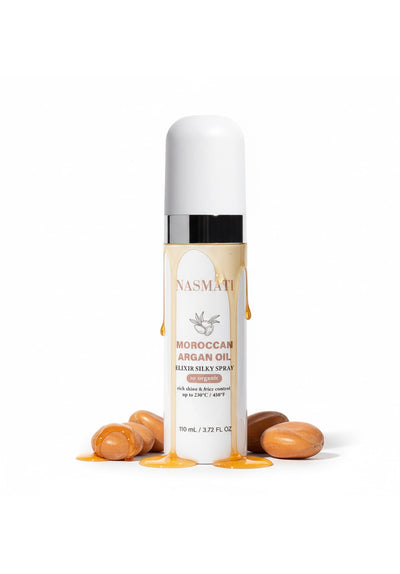
Moroccan Argan Oil Heat Protectant Spray
Prevents the moisture depletion that makes Lebanese hair brittle and prone to end breakage — used daily before heat tools and weekly as an overnight deep treatment that restores the cortex hydration that keeps strands flexible rather than snapping.
Shop Now →
Individual strand diameter is a direct function of cortex health. Damaged, dehydrated Lebanese hair has a physically smaller strand diameter than healthy, well-hydrated Lebanese hair from the same follicle — because the cortex shrinks when moisture-depleted. Restoring cortex moisture increases individual strand diameter measurably.
The science
Hair strand diameter is not fixed — it fluctuates based on cortex hydration. A healthy hair strand with 10–15% water content has a measurably larger diameter than the same strand at 5–6% water content. Consistent weekly deep Argan Oil treatments that penetrate the cortex and restore structural moisture increase individual strand diameter across the entire head over 4–8 weeks of consistent treatment — producing a genuine increase in perceived thickness that is not optical but physical. Lebanese women who notice their hair feeling "heavier" after consistent treatments are experiencing this increased strand diameter.
The weekly treatment
Night before wash day — apply Argan Oil generously to completely dry Lebanese hair, roots to ends. Leave overnight minimum 6 hours. Wash out in the morning. After 3–4 consistent weekly treatments, the difference in strand texture and perceived thickness is typically visible even before styling.
Lebanese hair that is thinning at the ends has often been thinning gradually overnight for years — through cotton pillowcase friction that removes the fine end sections progressively while the woman sleeps. This is invisible per night but significant across months and years.
The science
The fine end sections of Lebanese hair — which are the oldest part of each strand — are the most vulnerable to friction damage. Eight hours of cotton abrasion per night creates cumulative cuticle damage that causes these fine ends to break off progressively, creating the thinning, transparent end appearance that makes Lebanese hair look less dense than it actually is at the root. Switching to satin reduces overnight friction by up to 43% — immediately stopping the nightly removal of end density that has been occurring continuously without the Lebanese woman being aware of its cumulative impact.
Overnight Density Protection
Satin Crystal Scrunchies
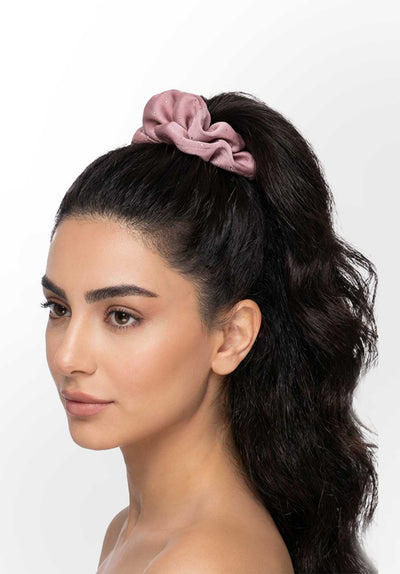
Secure Lebanese hair in a loose pineapple or low bun with satin every night — stops the progressive end breakage that has been reducing perceived thickness during sleep. Results in morning hair texture visible within 3–4 nights; cumulative density improvement visible within 2–3 weeks.
Shop Now →
Metal tools with hot spots are one of the primary causes of progressive density loss in Lebanese women — creating structural weak points that break off end sections with each styling session, month after month, until the hair looks visibly thinner than it did a year ago.
The science
Hot spots on metal tools permanently lift cuticle scales at their contact zones, weakening the strand at those exact contact points. These weakened zones become the break points that remove end density cumulatively. Over 52 weekly styling sessions, the hot-spot damage creates hundreds of structural weak points in the end sections that break off progressively — appearing as gradual thinning that the Lebanese woman attributes to "my hair just gets thin naturally" when it is actually tool-induced progressive density removal. Full ceramic eliminates hot spots entirely — stopping this density removal immediately on switching.
The switch
Replace any metal or worn tourmaline tools with full ceramic Nasmati alternatives. The hot-spot damage stops on day one of switching. The progressive end density improvement is visible as the hair grows out with intact ends over 8–12 weeks — Lebanese women describe it as their hair "suddenly seeming thicker" when in reality the thin broken ends have stopped accumulating.
What to Expect — Lebanese Hair Thickness Timeline
Day 1
Visual thickness doubles with root-to-curl technique, alternating directions, and Supercoat sealing. These methods cost nothing extra and produce same-day results.
Week 1–2
Morning hair noticeably thicker as overnight satin protection stops the nightly end breakage that has been thinning Lebanese hair during sleep for years.
Week 3–4
End density begins recovering as breakage from elastics and incorrect detangling is eliminated. Ends start looking fuller rather than tapered and transparent.
Week 6–8
Strand diameter increases from consistent Argan Oil deep treatments — Lebanese hair feels heavier, richer, and more substantial from the inside out.
Month 3+
Full density transformation visible. Lebanese women who apply all 8 methods consistently report hair that looks and feels genuinely thicker than it has in years — because both the optical and structural causes of thinness have been addressed simultaneously.
Lebanese Women on Getting Thicker Hair
★★★★★
"The curling from the root tip changed everything for me immediately. I always curled from the mid-length and wondered why my hair looked flat at the top. One session with the 5-in-1 starting at the root and it looked completely different."
— Maya, Beirut
★★★★★
"My hair has been thinning for two years. I thought it was genetic. After checking my brush I realized everything was short broken pieces — no root bulbs. Six weeks of stopping the breakage with the satin scrunchie and Argan Oil and my ends look thicker than they have in years."
— Rana, Jounieh
★★★★★
"I have genuinely fine hair — not just damaged thick hair — and Methods 1 and 2 are now a permanent part of my routine. The alternating curl direction creates a volume I could never get before. People ask if I got extensions."
— Nadia, Batroun
Thicker Lebanese hair is not a dream — it is a sequence of correct techniques and the right tools applied consistently. The complete Nasmati thickness system — 5-in-1 Curler, Comb Straightener, Argan Oil, Supercoat, Satin Scrunchies — free express shipping across Lebanon. 12-month warranty on every tool.
Shop the Full Nasmati Collection →
Find your personalized thickness plan — try the free AI Hair Analyzer →