Hair loss is one of the most distressing experiences Lebanese women face — and one of the most misunderstood. The first instinct is to buy a product. The correct first step is to identify the cause. Hair loss in Lebanese women has specific, identifiable causes — and most of them are either directly preventable through daily habits or significantly manageable with the right approach. This guide covers every major cause of hair loss Lebanese women face, the science behind each one, and the precise prevention strategies that work for Lebanese hair and Lebanese conditions.
Hair Loss Prevention Guide · Lebanon · 2026
Most hair loss Lebanese women experience is not genetic — it is environmental and habitual
Genetic pattern hair loss (androgenetic alopecia) accounts for a minority of hair loss cases in Lebanese women under 50. The majority of cases involve traction alopecia (from tight styles and elastic ties), breakage loss (from heat damage and mechanical stress), telogen effluvium (from stress, nutritional deficits, or hormonal shifts), and hard water damage (from Lebanon's mineral-heavy tap water). All four of these are preventable or reversible with the right information.
First — Shedding vs Hair Loss: Know the Difference
Most Lebanese women cannot distinguish normal shedding from actual hair loss — which leads to either unnecessary panic or missing a real problem that needs addressing.
✓ Normal Shedding
50–100 hairs per day — expected and healthy
Full-length hairs with a small white bulb at the root. Part of the normal hair growth cycle — the follicle releases old hairs to make room for new growth. If you see these in your brush, shower drain, or pillow: this is normal and does not require action.
⚠ Hair Loss to Address
Short broken pieces, thinning patches, or visible scalp
Short snapped hairs without a root bulb (breakage), patches of thinning at specific locations, a noticeably widening part, or visible scalp where density was previously full. These indicate a problem that requires identification and action — not just acceptance.
The 6 Main Causes of Hair Loss in Lebanese Women — And How to Stop Each One
Ordered from most to least preventable. The first three are entirely within your control to stop — starting today.
Traction alopecia is the most common and most preventable cause of hair loss in Lebanese women — and the one most often mistaken for genetic hair loss because it appears gradually along the hairline and temples, exactly where genetic thinning would appear.
The science
Repeated tension applied to the same follicles over months or years causes progressive follicle inflammation and eventually follicle death. Elastic hair ties, tight ponytails in the same position daily, tight braids, and heavy extensions all apply this concentrated tension. Lebanese women who wear tight ponytails with elastic ties in the same location daily for years often develop a distinctive thinning pattern at the hairline that is indistinguishable from early genetic hair loss — but is entirely caused by mechanical stress and entirely reversible if caught before follicle death occurs.
The fix — start immediately
Replace all elastics with Satin Scrunchies today. Vary your ponytail position daily — never the same point on the hair shaft two days in a row. Avoid tight styles entirely for 4–8 weeks to allow inflamed follicles to recover. If caught early, traction alopecia reverses completely within 3–6 months of removing the tension source.
Prevention Tool
Satin Crystal Scrunchies
Distributes hold across a wider surface area eliminating the concentrated stress point that causes follicle damage. The satin surface does not catch on the cuticle creating the friction that elastics generate around the tying point. Replace every elastic in your possession with these — the traction alopecia risk disappears immediately.
Shop Now →
The majority of what Lebanese women call "hair loss" in their 20s and 30s is not follicle loss — it is breakage from heat tools being used incorrectly on Lebanese hair. The visual result is identical to genuine hair thinning, but the cause and solution are completely different.
The science
Heat damage depletes cortex moisture progressively until Lebanese hair strands reach the brittleness threshold — below 6% water content — at which point they snap rather than flex under normal grooming stress. The resulting breakage occurs across the full length of the hair, creating the appearance of thinning density and reduced volume. Because breakage happens at many points along the shaft rather than at the root, the short broken hairs that accumulate create the same visual impression as genuine hair loss from follicle damage — leading Lebanese women to treat a heat damage problem with hair loss solutions that will not address it.
The fix
Check your brush after detangling. Short hairs without root bulbs = breakage, not loss. Apply Argan Oil before every heat tool session. Switch to ceramic tools to eliminate hot-spot damage. Begin weekly overnight Argan Oil deep treatments. Breakage-related apparent thinning reverses within 6–12 weeks of consistent protection and restoration — unlike genuine follicle hair loss which is much harder to reverse.
Prevention Tool
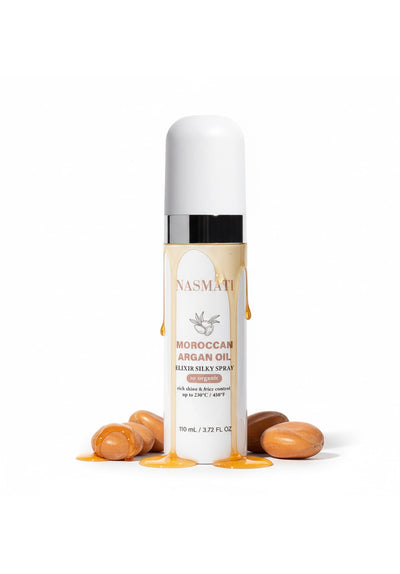
Moroccan Argan Oil Heat Protectant Spray
Prevents the moisture depletion that causes brittleness and breakage-related apparent thinning — used daily before heat tools and weekly as a deep cortex restoration treatment. Addresses both the immediate and cumulative causes of heat-related hair loss simultaneously.
Shop Now →
Lebanon's tap water is one of the most underrecognized contributors to hair thinning and follicle stress among Lebanese women. The mineral content in Lebanese water affects both the hair shaft and the scalp directly — and the effect compounds with every wash.
The science
High calcium and magnesium content in Lebanese tap water does two things simultaneously: (1) coats hair shafts with mineral deposits that block moisture absorption and make hair progressively more brittle and prone to breakage, and (2) deposits mineral scale on the scalp surface that can block follicle openings and create the low-grade scalp inflammation that impairs healthy hair growth over time. Research on hard water exposure shows measurable reductions in hair tensile strength after consistent hard water washing — and Lebanese women washing daily in hard water accelerate this process significantly compared to those washing every 3–4 days.
The fix
Reduce wash frequency to limit hard water contact. Use an apple cider vinegar rinse monthly (1 tablespoon in 1 cup water) to dissolve mineral deposits on scalp and hair shaft — the mild acidity breaks down calcium and magnesium buildup without stripping natural oils. If possible, install a shower filter. Apply Argan Oil after every wash to restore the moisture barrier that hard water deposits disrupt with each wash cycle.
Telogen effluvium — stress-triggered excessive shedding — is the most common form of true hair loss in Lebanese women, driven by Lebanon's high chronic stress environment. It is frequently misdiagnosed as genetic hair loss and treated with solutions that do not address its actual cause.
The science
Physical or psychological stress triggers a hormonal response that shifts a large number of hair follicles simultaneously from their growth phase (anagen) into their resting phase (telogen). 2–3 months after the stress event, these follicles shed their hairs simultaneously — producing the sudden, alarming diffuse thinning that Lebanese women often describe as their "hair falling out overnight." This is not permanent follicle loss — the follicles are intact and will regrow hair once the stress trigger is resolved. The shed hair typically regrows fully within 6–9 months. The most important thing Lebanese women can do during this period is protect the regrowth from breakage as it comes in.
The fix
Identify and address the stress trigger where possible. Support the regrowth period by ensuring maximum protection of new hairs as they come in — apply Argan Oil regularly, use only satin scrunchies, sleep with satin protection nightly, and avoid any additional tension or heat stress on the scalp. Telogen effluvium resolves on its own when the trigger is removed — the Lebanese women who recover fastest are those who protect the new growth through the regrowth cycle.
Nutritional deficiencies are a significant and underdiagnosed contributor to hair loss in Lebanese women — particularly iron deficiency, which is common in Lebanon due to dietary patterns, and Vitamin D deficiency, which despite Lebanon's sunny climate affects a significant proportion of the population.
The science
Iron is essential for the cellular energy production in hair follicles — follicles are among the most metabolically active cells in the body and require consistent iron supply to maintain the anagen (growth) phase. Iron deficiency is one of the most common reversible causes of diffuse hair thinning in Lebanese women under 40. Vitamin D receptors exist in hair follicles — deficiency is associated with miniaturization of follicles and shortened growth cycles. A blood test measuring ferritin (stored iron) and Vitamin D levels is the single most valuable diagnostic tool for Lebanese women experiencing unexplained hair thinning — far more so than any topical product.
The fix
Get a blood panel testing ferritin, Vitamin D, zinc, and thyroid function (TSH) before buying any hair loss product. If ferritin is below 70 µg/L — even within "normal" range — supplementation is often recommended for hair-loss-related iron deficiency. Vitamin D deficiency in Lebanon is widespread and easily corrected with supplementation. These nutritional fixes produce visible regrowth improvement within 3–6 months of optimizing levels.
Androgenetic alopecia (genetic pattern hair loss) and hormonal hair loss from PCOS, thyroid disorders, or post-partum hormonal shifts are real causes of hair thinning in Lebanese women — but they are less common than the five preventable causes above and require medical evaluation and treatment rather than lifestyle changes alone.
The science
Genetic hair loss in women involves the conversion of testosterone to dihydrotestosterone (DHT) in hair follicles — causing progressive miniaturization of follicles primarily at the crown and top of the scalp. PCOS-related hair loss follows a similar hormonal pathway. Post-partum telogen effluvium is temporary (see Cause 4) but can be severe. The key diagnostic feature distinguishing hormonal/genetic hair loss from the preventable causes above is the pattern — diffuse thinning at the crown that persists despite addressing traction, heat, and nutrition is the signal to consult a dermatologist rather than continue attempting self-treatment.
The Complete Lebanese Hair Loss Prevention Plan — Daily Actions
Tonight
Replace all elastics with Satin Scrunchies. Sleep with loose pineapple or low bun. Eliminates traction alopecia and overnight breakage simultaneously — the two most common preventable hair loss causes for Lebanese women.
Every session
Apply Argan Oil before every heat tool use. No exceptions. Prevents the moisture depletion breakage that creates apparent thinning — stops the most common "hair loss" Lebanese women in their 20s and 30s experience.
Weekly
Overnight Argan Oil deep treatment before wash day. Restores cortex moisture and maintains the tensile strength that prevents breakage-related thinning accumulating over months.
Monthly
Apple cider vinegar scalp rinse to remove hard water mineral buildup. Keeps follicle openings clear and scalp environment healthy for optimal hair growth.
Once
Blood panel: ferritin, Vitamin D, zinc, TSH. If Lebanese hair thinning is diffuse and does not improve with the habit changes above within 8–12 weeks — nutritional or hormonal causes are likely. This test identifies them definitively.
Daily
Vary ponytail position. Never the same tension point two days in a row. The follicles around the hairline and temples are the most vulnerable to traction alopecia and the slowest to recover once damaged.
Important — When to Seek Medical Help
See a dermatologist if you notice any of the following
• Thinning specifically at the crown or top of the scalp that progresses over months
• Visible patches of complete hair loss (alopecia areata — requires dermatological treatment)
• Hair loss accompanied by other symptoms: fatigue, weight change, irregular periods, scalp itching or inflammation
• Hair loss that does not improve after 12 weeks of consistent application of the preventable-cause fixes above
• Sudden severe shedding — more than 200–300 hairs per day — particularly 2–3 months after a major illness, surgery, or significant stress event in Lebanon
Lebanese Women on Hair Loss Prevention
★★★★★
"I thought I was going bald. Checked my brush after reading this and everything was short broken pieces — not real loss, just breakage from my metal straightener. Three months of the Argan Oil routine and ceramic tools and my hair looks thicker than it has in years."
— Rima, Beirut
★★★★★
"The traction alopecia section described my hairline exactly — I had been wearing tight ponytails in the same spot for 10 years. Switched to satin scrunchies 6 months ago and my hairline has genuinely filled back in at the temples."
— Nour, Jounieh
★★★★★
"The blood panel tip was the most valuable thing I read. My ferritin was 22 — within 'normal' range but way too low for hair health. Three months of iron supplementation and my shedding reduced dramatically."
— Lara, Baabda
Most Lebanese hair loss is preventable. Identify the cause — then eliminate it. The Nasmati prevention toolkit — Argan Oil, Satin Scrunchies, Supercoat, ceramic tools — addresses the four most common preventable causes of Lebanese hair loss. Free express shipping across Lebanon. 12-month warranty on every tool.
Shop the Full Nasmati Collection →
Find your personalized hair health plan — try the free AI Hair Analyzer →