Frizz is not a hair type. It is not something Lebanese women are simply born with and have to accept. Frizz is a symptom — of a specific, identifiable cause — and every cause has a specific fix. Lebanese women deal with some of the most aggressive frizz conditions in the Arab world: coastal humidity, hard tap water, daily heat styling, and the AC-to-outdoor temperature cycle that opens and closes the hair cuticle multiple times per day. This guide breaks down every frizz cause Lebanese hair faces, the science behind each one, and the exact Nasmati product and technique that eliminates it.
Nasmati Anti-Frizz Guide · Lebanon
Every frizz cause has a specific fix. Here are all of them — for Lebanese hair specifically.
6Frizz causes covered
6Science-backed fixes
100%Lebanon-specific
FreeShipping Lebanon
The 6 Types of Frizz Lebanese Women Face — and the Fix for Each
Each type of frizz has a different cause and requires a different solution. Treating all frizz the same way is why most anti-frizz attempts fail.
The most common Lebanese frizz type. Hair looks perfect when you leave the house and turns into a halo of frizz within 20 minutes outdoors. This is not a styling failure — it is an unsealed cuticle problem. The fix is sealing, not restyling.
The science
Heat styling opens the hair cuticle to reshape it. When the cuticle is not sealed immediately after styling, it remains partially open and positively charged. Beirut's coastal humidity — water molecules with negative charge — are attracted to these open, positive cuticle scales and enter the cortex, disrupting hydrogen bonds and distorting the style from inside the strand. The frizz starts from inside the hair, not from the surface.
The fix
Apply a humidity-sealing product immediately after styling — before any outdoor exposure. The goal is to seal the cuticle shut and create a barrier that blocks water molecules from entering. This must happen before humidity exposure, not after frizz has already started. Apply every time, without exception, on any day you style in Lebanon.
Nasmati Fix
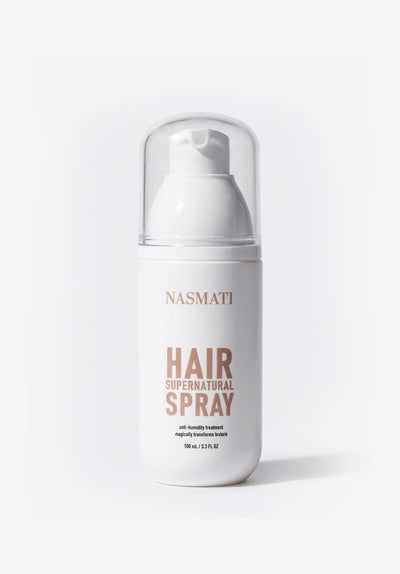
Supernatural Anti-Frizz Humidity-Proof Supercoat
Creates a humidity-proof barrier over the sealed cuticle — blocking water molecules from entering and disrupting your style. Built specifically for Lebanon's coastal and mountain humidity levels. Apply after every styling session, before outdoor exposure.
Shop Now →
This frizz does not go away after styling — it is present even on freshly styled hair, even on dry days, and it gets progressively worse over months of styling. This is structural frizz caused by cumulative heat damage to the cuticle that cannot be resolved by any amount of sealing product alone.
The science
Repeated heat application without protection permanently lifts cuticle scales by breaking the bonds that hold them flat. Once lifted, these scales do not lie flat again — they scatter light (causing dullness), catch on each other (causing tangles), and absorb humidity faster than intact cuticles (causing frizz in all conditions, not just humid ones). Lebanese women who have been styling without heat protectant for years will have varying degrees of this permanent cuticle damage.
The fix
Two-part solution: (1) Stop adding damage immediately — apply heat protectant before every styling session from this point forward. (2) Begin a weekly deep restoration routine with Argan Oil to help the cortex retain moisture despite the compromised cuticle. Full cuticle repair is not possible, but stopping new damage and restoring cortex moisture significantly reduces structural frizz within 4–8 weeks of consistent care.
Nasmati Fix
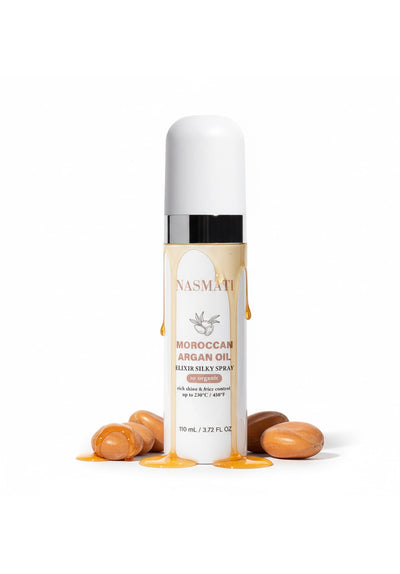
Moroccan Argan Oil Heat Protectant Spray
Prevents new heat damage frizz with every styling session while simultaneously restoring cortex moisture that past damage has depleted. Apply before every heat tool use AND weekly as a standalone deep treatment to reverse existing structural frizz over time.
Shop Now →
Hair that is chronically dry frizzes in any condition — not just in humidity. This type of frizz is present even on dry winter days in Lebanon and does not respond well to anti-frizz products because the underlying problem is insufficient moisture inside the hair shaft, not surface texture.
The science
Healthy hair contains 8–15% water by weight. When this drops below 6% — from a combination of heat styling, Lebanon's hard tap water mineral deposits, AC dehydration, and sun exposure — the hair shaft becomes brittle and inflexible. Brittle hair does not lie flat; its stiffness causes the shaft to kink and lift unevenly even in the absence of humidity. This is the frizz that conditioner never fully resolves because conditioner moisturizes the surface — not the cortex where the deficit actually lives.
The fix
Weekly deep oil penetration treatment. Apply Argan Oil to dry hair (not damp) — leave 5–10 minutes — brush through from ends upward. For severe dryness, leave overnight before wash day. Argan oil's small molecular size allows it to bypass the cuticle and penetrate the cortex directly, restoring structural moisture that surface conditioners cannot reach. Consistency is essential — visible improvement typically takes 3–4 weekly treatments.
Nasmati Fix
Moroccan Argan Oil — Weekly Deep Treatment
Restores the structural cortex moisture that dryness frizz depletes — addressing the cause, not the symptom. Apply generously to dry Lebanese hair weekly, leave 5–10 minutes or overnight before wash day. The transformation in frizz level and hair texture is consistently one of the most visible improvements women report within the first month.
Shop Now →
Frizz that appears immediately after brushing — especially on naturally curly or wavy Lebanese hair — is mechanical frizz. It is created by the physical act of brushing in a way that disrupts the hair's natural structure rather than smoothing it. The tool and technique are both wrong.
The science
When a brush with stiff or closely-spaced bristles passes through Lebanese hair, it physically separates the natural clumping of strands that keeps the cuticle aligned. For curly and wavy Lebanese hair, this breaks apart the curl clumps that define the pattern — leaving individual strands standing separately, each one charged with static from the friction. On thick Lebanese hair, a brush with accumulated hair in its bristles creates additional resistance that lifts cuticle scales as it passes through.
The fix
For curly Lebanese hair: never brush dry. Detangle only when damp with Argan Oil applied first, using a wide-spaced brush from ends upward. For straight and thick Lebanese hair: replace your brush when bristles show resistance or buildup — a brush clogged with accumulated hair creates 3× more friction against the cuticle than a clean brush. Clean your brush after every single use.
Nasmati Fix
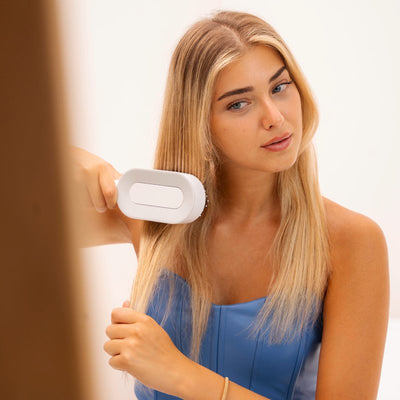
Self-Cleaning Hair Brush
Flexible bristles that minimize mechanical friction on thick Lebanese hair — and one-press self-cleaning that removes all accumulated hair instantly, so every brushing session starts with clean bristles at consistent, low friction. The difference in mechanical frizz between a clogged brush and a clean one is immediately visible on Lebanese hair.
Shop Now →
Waking up with significantly frizzier hair than you went to sleep with is not normal — it is predictable and entirely preventable. Cotton pillowcases and unsecured hair create 8 hours of continuous friction every night that undoes whatever styling was done the day before.
The science
Cotton fabric has a rough microscopic surface that catches on hair's cuticle scales during sleep movement. Over 8 hours and hundreds of contact events, this friction progressively lifts cuticle scales — creating the rough, frizzy texture that Lebanese women face every morning. For thick Lebanese hair, the problem is compounded because there are more strands creating more friction contact per movement. The morning frizz is not from sleeping — it is from the specific abrasion of cotton against an unsealed cuticle for 8 consecutive hours.
The fix
Two changes: (1) Secure hair in a loose gathering at the crown (pineapple technique for curly hair) or a low loose bun at the nape (for straight/thick hair) using a satin scrunchie before sleep — this keeps most of the hair off the pillow surface entirely. (2) If possible, switch to a satin or silk pillowcase — satin creates up to 43% less friction against hair than cotton. The satin scrunchie alone produces visible morning frizz reduction within 3–4 nights.
Nasmati Fix
Satin Crystal Scrunchies
Satin surface glides over Lebanese hair's cuticle instead of catching on it — eliminating the overnight friction that creates morning frizz. The simplest habit change in this entire guide, with one of the most immediate visible results. Wear every night, starting tonight.
Shop Now →
The frizz that appears selectively on certain sections after styling — some curls smooth, others frizzy — despite identical technique on every section. This is hot spot frizz caused by the tool, not the technique. And it gets worse the older your non-ceramic tool gets.
The science
Metal and worn tourmaline-coated tools develop temperature hot spots — zones that heat 15–30°C higher than the stated temperature due to uneven electrical resistance in the heating element. When these hot spots contact thick Lebanese hair, they cause localized overheating that permanently lifts cuticle scales in that contact zone. The result is a section that frizzes regardless of humidity or product — because its cuticle is structurally damaged at the point of hot-spot contact. This damage is cumulative and invisible session-by-session until the hair "suddenly" becomes difficult to smooth.
The fix
Replace metal or worn tourmaline-coated tools with full ceramic alternatives. Ceramic's thermal properties distribute heat uniformly across the entire barrel or plate surface — eliminating hot spots entirely. The switch to ceramic will not reverse existing hot-spot frizz damage, but it will immediately stop new damage from accumulating and allow the weekly Argan Oil restoration to slowly improve the affected sections over time.
Nasmati Fix
5-in-1 Magic Hair Curler — Full Ceramic
Full ceramic barrels with zero hot spots — every contact point on every section of thick Lebanese hair receives identical, even heat. The selective section frizz that non-ceramic tools cause disappears immediately on switching. CE, FCC, ROHS certified for consistent thermal performance across the full product life.
Shop Now →
The Complete Frizz-Free Routine for Lebanese Women
Before
Weekly: Apply Argan Oil to dry hair as a deep treatment — leave 5–10 min, brush through from ends up. Restores cortex moisture that prevents dryness frizz.
Step 1
Every session: Apply Argan Oil Heat Protectant to every section before any heat tool. Creates the thermal barrier that prevents heat damage frizz from accumulating.
Step 2
During styling: Use full ceramic tools (5-in-1 Curler or Comb Straightener) — eliminating hot spot frizz from tool contact entirely.
Step 3
After styling: Apply Supercoat immediately before any outdoor or humid exposure — sealing the cuticle against Beirut's humidity frizz.
Daily
Brushing: Use the Self-Cleaning Brush from ends upward on dry hair — eliminating mechanical frizz from bristle friction and buildup.
Nightly
Before sleep: Secure in loose pineapple or low bun with Satin Scrunchie — eliminating overnight cotton friction frizz every morning.
What Lebanese Women Say After Following This Guide
★★★★★
"I live in Beirut and frizz was just a fact of life for me. After following the Nasmati routine — Argan Oil before styling, Supercoat after — my hair holds all day even in July. I genuinely cannot believe the difference."
— Rana, Beirut
★★★★★
"The overnight tip changed everything. I wake up with hair that looks almost the same as when I styled it the night before. The satin scrunchie sounds too simple to work — but it absolutely does."
— Joelle, Baabda
★★★★★
"The selective frizz on certain sections was driving me crazy for years. Switching to the ceramic 5-in-1 made it disappear immediately. It really was the hot spots on my old curler the whole time."
— Nadia, Jounieh
Frizz is not permanent. Every type of frizz Lebanese women face has a specific, fixable cause. The complete Nasmati anti-frizz system — Argan Oil, Supercoat, ceramic tools, Satin Scrunchies, Self-Cleaning Brush — ships free across Lebanon. 12-month warranty on every tool.
Shop the Full Nasmati Collection →
Find your exact frizz fix — try the free AI Hair Analyzer →