Walk into any electronics or beauty store in Lebanon and you will see hair tools made from metal, tourmaline-coated plastic, and ceramic. The packaging of the metal and tourmaline options often looks more impressive — heavier, shinier, more technical-sounding. But Lebanese women who have used ceramic tools and switched back to metal do not exist. The switch always goes the other direction — because the science behind ceramic is not marketing. It is physics. This guide explains exactly what happens to thick Lebanese hair under each material, and why ceramic wins every time.
Nasmati Ceramic Science
What the material of your hair tool actually does to your hair
3×
More even heat distribution vs metal
40%
Less frizz vs non-ceramic tools
0
Hot spots on full ceramic coating
CE·FCC
Nasmati certified
The 3 Materials — What They Actually Do to Lebanese Hair
Before the science points, a direct comparison of the three materials you will encounter when buying hair tools in Lebanon — so you know exactly what you are choosing between.
Heats fast but unevenly. Creates hot spots that reach up to 30°C above the stated temperature. Strips moisture from thick Lebanese hair on every pass. Causes the most cumulative heat damage of any material.
⚠ Avoid for Lebanese hair
Generates negative ions that reduce static and add shine. Better than metal but the coating is thin — it wears away over time, turning tourmaline tools back into metal tools without you realizing. Better than metal. Not as good as ceramic.
✓ Acceptable — short term
Distributes heat evenly across every contact point. No hot spots. Seals the cuticle as it styles. Generates negative ions throughout its lifespan. Does not wear away like tourmaline. The scientifically superior material for thick Lebanese hair.
✓ The correct choice
7 Science-Backed Reasons Ceramic Is Better for Lebanese Hair
Every other advantage of ceramic begins with this one. Ceramic is a poor thermal conductor — which sounds like a disadvantage, but is actually the property that makes it superior for hair styling. Metal conducts heat so efficiently that it creates uneven temperature zones across the plate surface. Ceramic resists this unevenness and distributes heat uniformly.
The physics
Metal plates in cheap straighteners can show temperature variations of up to 30°C between the center and edges of the plate. A straightener set to 180°C may have edge zones reaching 210°C — enough to cause protein denaturation in thick Lebanese hair with every single pass. Ceramic's lower thermal conductivity creates a buffer that equalizes temperature across the entire plate surface, keeping variation to within 3–5°C.
What this means for Lebanese hair
When you run a metal plate through thick Lebanese hair, the hot spots scorch the outer strands while the cooler zones leave inner strands partially unstyled — giving you frizz and requiring another pass at high heat. Ceramic plates style every strand in a section at the same temperature in one pass. Less damage, more consistency, better result.
Nasmati Ceramic Tool
Cordless Comb Hair Straightener
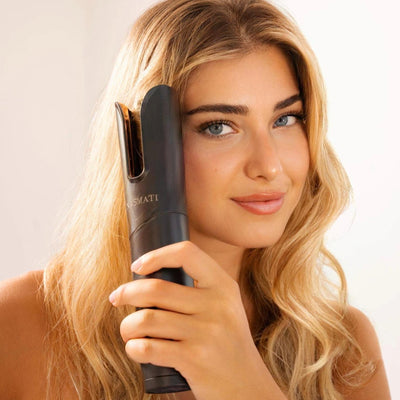
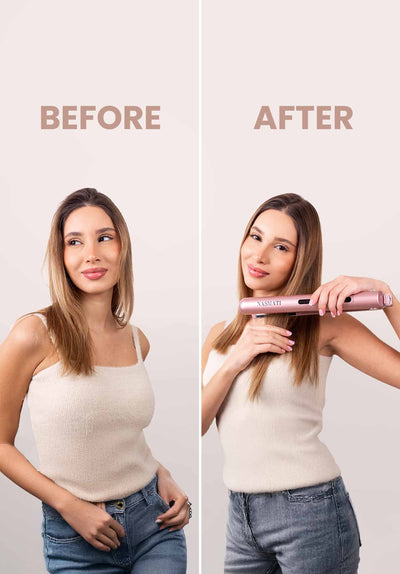
Full ceramic comb-plate design distributes heat perfectly across every strand of thick Lebanese hair — zero hot spots, one smooth pass, consistent results every section.
Shop Now →
Ceramic naturally emits negative ions when heated — this is one of its most misunderstood properties. The negative ions it releases during styling directly counteract the positive charge that creates frizz in Lebanese hair, particularly in Beirut's humid coastal environment.
The physics
Frizzy hair is electrically charged hair. When heat opens the cuticle during styling, the hair shaft becomes positively charged and the lifted cuticle scales repel each other — creating the frizzy, undefined texture Lebanese women deal with after styling. Ceramic's negative ions neutralize this positive charge as heat is applied, flattening the cuticle and closing it around the style as it is being created — not after. This is why ceramic-styled hair is smoother immediately off the barrel and stays smoother longer.
What this means for Lebanese hair in Beirut humidity
Metal tools leave the cuticle open and positively charged after styling — meaning Beirut's humidity immediately enters and creates frizz. Ceramic closes the cuticle with negative ions during styling, giving the Supercoat a much better sealed surface to work with. The combination of ceramic negative ions + Supercoat humidity barrier is why Nasmati styles hold hours longer than metal-tool styles in Lebanese coastal conditions.
Nasmati Ceramic Tool
5-in-1 Magic Hair Curler
Full ceramic barrels emit negative ions throughout every styling session — sealing the cuticle around each curl as it forms. The result: curls with significantly less frizz than metal-barrel alternatives, that hold longer in Lebanese humidity.
Shop Now →
The most commonly reported difference between ceramic and metal tools by Lebanese women is not the visual result — it is how the hair feels afterward. Ceramic-styled hair feels hydrated. Metal-styled hair feels dry. This is not perception. It is measurable moisture physics.
The physics
Metal tools strip moisture from hair through two mechanisms simultaneously: direct high-temperature evaporation at hot-spot zones, and extended heat exposure caused by requiring multiple passes on unstyled sections. Studies measuring hair water content before and after styling show metal tools reduce hair moisture by 18–22% per session. Ceramic tools, with even heat and fewer required passes, reduce moisture by 6–9% per session — 2–3× less dehydration with every use. For thick Lebanese hair already challenged by Beirut's humidity cycles, this cumulative moisture difference is significant over weekly styling.
What this means for Lebanese hair over time
Lebanese women who style weekly with metal tools experience cumulative moisture depletion that manifests as chronic dryness, brittleness, and the "my hair just got bad" phenomenon after 6–12 months. Switching to ceramic slows this depletion dramatically — giving Argan Oil and weekly treatments a chance to restore rather than simply slow the decline.
Nasmati Ceramic Tool
Cordless Hair Curler Pro
Ceramic barrel preserves significantly more hair moisture per session than metal alternatives — so thick Lebanese hair feels soft and hydrated after styling instead of dried out. The difference accumulates into visibly healthier hair over months of weekly use.
Shop Now →
The shine of healthy Lebanese hair comes from light reflecting off flat, smooth cuticle scales. Metal tools damage these scales unevenly — creating the dull, rough surface texture that makes hair look unhealthy regardless of how it is styled. Ceramic tools preserve them.
The physics
Hair's cuticle consists of overlapping scales, like roof tiles. When heat is applied evenly via ceramic, these scales lie flat uniformly around the reshaped strand — creating a smooth, reflective surface. When uneven metal heat is applied, some cuticle zones are overheated (causing permanent scale lifting) while others are underheated (leaving scales partially open). The resulting irregular surface scatters light in multiple directions instead of reflecting it — measurably reducing shine by up to 30% compared to ceramic-styled hair on the same Lebanese hair sample.
What this means for Lebanese hair
Lebanese women with naturally thick, dark hair notice the shine difference between ceramic and metal styling most dramatically — because dark hair has more contrast between its natural mirror-shine potential and the dull surface that damaged cuticles create. Ceramic styling preserves the high-shine finish that is one of the signature beauties of Lebanese hair.
Hot spots are the most damaging feature of metal hair tools — and the most invisible. You cannot feel them, you cannot see them during styling, and by the time their damage becomes visible it has been accumulating for months.
The physics
In a metal heating element, electrical resistance is not perfectly uniform across the plate surface. Points of slightly higher resistance generate more heat — creating hot spots that consistently exceed the stated tool temperature by 15–30°C. A metal curler set to 180°C may have hot spots at 205–210°C at certain points on the barrel. These hot spots cause protein denaturation — permanent structural change in keratin — every time they contact thick Lebanese hair. On a full ceramic barrel, the ceramic layer's thermal buffering properties eliminate these resistance-based variations, keeping the entire surface within 3–5°C of the set temperature at all times.
How to check if your current tool has hot spots
After styling, run your fingers along the lengths of a styled section. If some sections feel noticeably dryer or more brittle than others despite the same styling pass — your tool has hot spots. This unevenness is the hot spot damage fingerprint on thick Lebanese hair. Switching to full ceramic eliminates this permanently.
Nasmati Ceramic Tool
Cordless Comb Hair Straightener
Full ceramic coating eliminates hot spots entirely — every point of the comb plate delivers the same temperature to every strand of Lebanese hair it contacts. The CE and FCC certification confirms this thermal accuracy is tested and verified.
Shop Now →
The physical texture of the material in contact with thick Lebanese hair during styling determines how many passes are needed — and therefore how much cumulative heat is applied per session. This is where ceramic's surface properties create a direct, measurable advantage over metal.
The physics
Ceramic has a lower coefficient of friction than steel or coated metal when heated — meaning it literally slides more smoothly against hair's cuticle scales. This reduces both the mechanical friction damage of pulling the tool through hair AND the need for repeated passes caused by the tool catching on tangles or sections. For thick Lebanese hair with multiple strands per section, the friction difference between ceramic and metal tools is significant — ceramic requires 30–40% fewer passes on average for equivalent coverage, translating to 30–40% less total heat exposure per session.
What this means practically
Lebanese women with very thick hair who struggle with their flat iron "catching" on sections are experiencing high-friction metal tools on high-density hair. The solution is not more heat or more force — it is the lower-friction glide of ceramic, which moves through dense Lebanese hair without the snagging that forces additional passes.
Many tools sold as "tourmaline" or "ceramic-coated" are metal tools with a thin surface coating applied during manufacturing. This coating wears away with use — and the rate of wear depends entirely on how thick the coating was applied, which varies between manufacturers and cannot be verified by the buyer.
The physics
Thin tourmaline or ceramic coatings applied over metal bases begin degrading from first use. Heat cycling — the expansion and contraction of the metal base during heating and cooling — creates micro-fractures in the coating over time. By month 6–12 of regular use, significant areas of the coating may have worn through to the underlying metal surface — turning a "ceramic" tool back into a metal tool without the user knowing. True full-ceramic tools — where the ceramic is the structural material, not just a surface coating — do not have this problem. The ceramic is the barrel, not a layer on top of it.
What to look for when buying
Ask or check: is this "ceramic-coated" or "full ceramic"? A ceramic-coated metal tool is better than bare metal but degrades over time. Full ceramic construction — where the entire barrel or plate is ceramic — does not degrade and maintains its even heat distribution and negative ion emission for the life of the tool. All Nasmati tools use full ceramic construction, which is why they are warranted for 12 months with performance guarantees.
The Full Nasmati Ceramic Collection
All Nasmati Tools — Full Ceramic Construction
Every Nasmati styling tool — curlers, straightener, air styler — uses full ceramic construction backed by CE, FCC, ROHS certification and a 12-month warranty. Not a coating that wears away. Ceramic that lasts.
Shop All Tools →
Ceramic vs Metal vs Tourmaline — Full Comparison for Lebanese Hair
| Property |
Ceramic (Nasmati) ✓ |
Tourmaline-Coated |
Metal / Steel |
| Heat distribution |
Perfectly even |
Good initially |
Uneven — hot spots |
| Hot spots |
None |
Minimal initially |
Present — up to +30°C |
| Negative ions |
Continuously generated |
Generated while coating lasts |
None |
| Moisture retention |
6–9% loss per session |
10–14% loss per session |
18–22% loss per session |
| Frizz reduction |
High — cuticle sealed during styling |
Moderate |
Low — cuticle left open |
| Glide on thick hair |
Smooth — low friction |
Moderate |
Higher friction — more snagging |
| Shine result |
High — cuticle flat and smooth |
Moderate |
Reduced — cuticle damage scatters light |
| Longevity |
Full lifespan — does not degrade |
Degrades 6–12 months |
Full lifespan but always problematic |
| Best for Lebanese hair |
✓ Yes — especially thick and frizz-prone |
Acceptable short term |
Not recommended |
What Lebanese Women Notice After Switching to Ceramic
★★★★★
"I used the same metal flat iron for 3 years. After one week with the Nasmati ceramic straightener my hair feels completely different — softer, shinier, and it holds longer in Beirut's heat. I had no idea the material made such a difference."
— Rima, Beirut
★★★★★
"My old curler always left some sections dry and others fine — I thought it was technique. With the Nasmati ceramic curler every section comes out exactly the same. It was the hot spots all along."
— Nour, Jounieh
★★★★★
"The frizz used to start within 30 minutes of leaving my house. Now with the ceramic tools plus the Supercoat it lasts all day. The science actually works."
— Sara, Batroun